
At an industry conference in New Delhi this month, speakers cited a global survey that should bother every plant head in India. It found that 88% of Indian industrial businesses suffer an unplanned outage at least once a month, against 69% worldwide, at a cost of nearly ₹70 lakh an hour. Separately, 19% of Indian respondents still rely on run-to-fail breakdown maintenance.
Plenty of plants with outages that frequent will have a preventive schedule on paper. It sits in a file, a planner can show it to an auditor, and services on it fall due every week. What it lacks is any power over a production plan that is behind on orders. When a due service meets a late order, the order wins and the service moves to next week. Then it moves again.
This article explains why that happens, how to measure how bad it is in your plant, and what to change so that scheduled maintenance survives a busy month.
Three agreements make scheduled maintenance hold
Scheduled maintenance holds when three things are agreed before the quarter’s orders are booked. The service window sits in the same calendar as production. The spare part is reserved against the due date. Compliance is measured in hours worked, not tickets closed. An ERP helps because it already holds the production plan, the stock and the purchase orders, so preventive maintenance scheduling can live in one system instead of in three people’s memories. Without these agreements, a maintenance schedule is a request that production is free to edit.
Production wins the calendar fight before it starts
In most plants the maintenance schedule and the production schedule are built by different people, in different files, and meet only when they collide. A service comes due on Thursday. The planner never saw it, because it was not on the board she books machine time against. On Thursday the technician arrives, the machine is running a rush order, and the shift supervisor sends him away, which is a sensible thing for a supervisor to do. Nobody was careless. Deferral was the rational result of how the information flowed.
The cost compounds. Every deferred service raises the chance of a failure, and every failure pulls technicians into breakdown maintenance, which leaves less time for the next planned service. Practitioners describe this as a death spiral, and its early signal is easy to spot: the same three services have been rescheduled for a month.
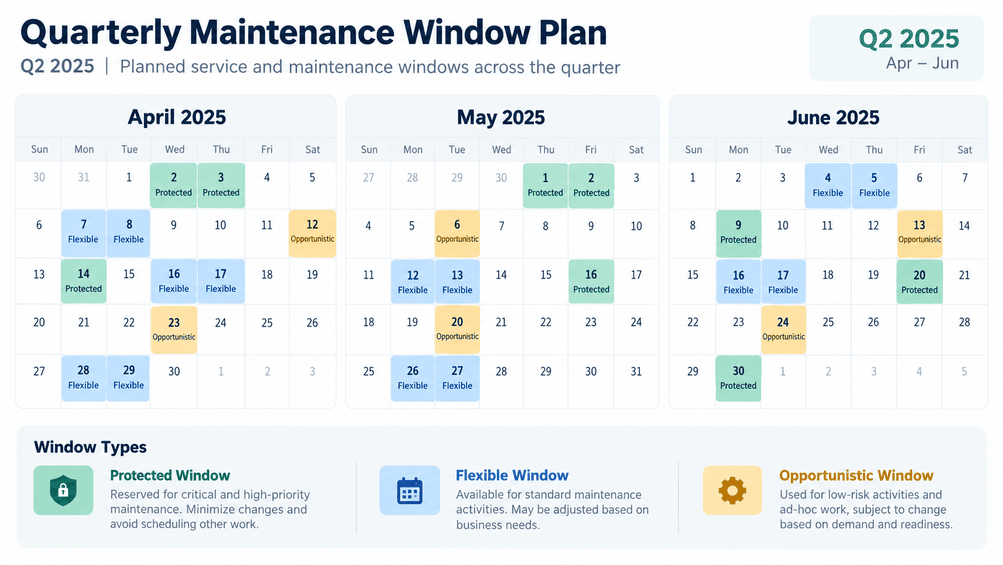
The fix is a window policy with three tiers. Protected windows are agreed jointly between production and maintenance when the quarter is planned, at least 90 days ahead, and published in the production schedule. Flexible windows can slide within a five-day band. Opportunistic windows are used whenever a line has a gap. Any change to a protected window needs a named production manager’s approval, recorded in the system.
The tradeoff is real. Protected windows will sometimes cost you a shipment. Price that before you object, using hours stopped multiplied by margin per hour, and compare it with the cost of the failure the window prevents. The policy survives only if the plant head backs it the first time a customer calls about a late order.
The compliance number that hides the firefighting
PM compliance, the share of scheduled services completed on or before their due date, is the most honest figure a maintenance team produces, and the way it is usually reported flatters the plant. Practitioners treat a rate below roughly 70 to 80 percent as a reactive plant with a calendar attached. A plant can also post a respectable ticket count and still lose most of its technician hours to emergencies, because a quick lubrication closes as fast as a gearbox rebuild.
A 2026 survey of 2,234 maintenance and operations leaders in North America found that 79% saw downtime stay flat or rise. Having a schedule does not change that on its own. Run this diagnostic with your planner before the next review:
- What share of PM work orders closed on or before the due date last quarter, month by month rather than averaged?
- Of the hours your technicians worked last month, how many went to planned work?
- Which assets caused the last ten unplanned stops, and did any of them have a service due in the month before?
The third question catches the failure that surprises people most: a plant with 95% compliance whose services land on the wrong assets.
One counterintuitive finding follows. Fix execution before you tune intervals. If services run late, you cannot tell whether an interval is wrong or simply unmet, so teams that jump to optimisation end up revising a schedule they never followed. Hold compliance steady for a quarter, then adjust intervals, switching to running hours for machines that do not run on a regular pattern.
Availability is the OEE lever these stops drag down, and our piece on how OEE exposes the capacity you have already bought shows how to calculate it. Compliance moves first, which makes it the better early warning.
The work order waiting for a bearing
A service comes due, the window is protected, the technician arrives, and the part is not there. He inspects the machine, notes the wear, writes part to be ordered and closes the order, because the only statuses available are open and done. The plant has just paid for preventive observation. The machine is no healthier, and the record says the service happened.
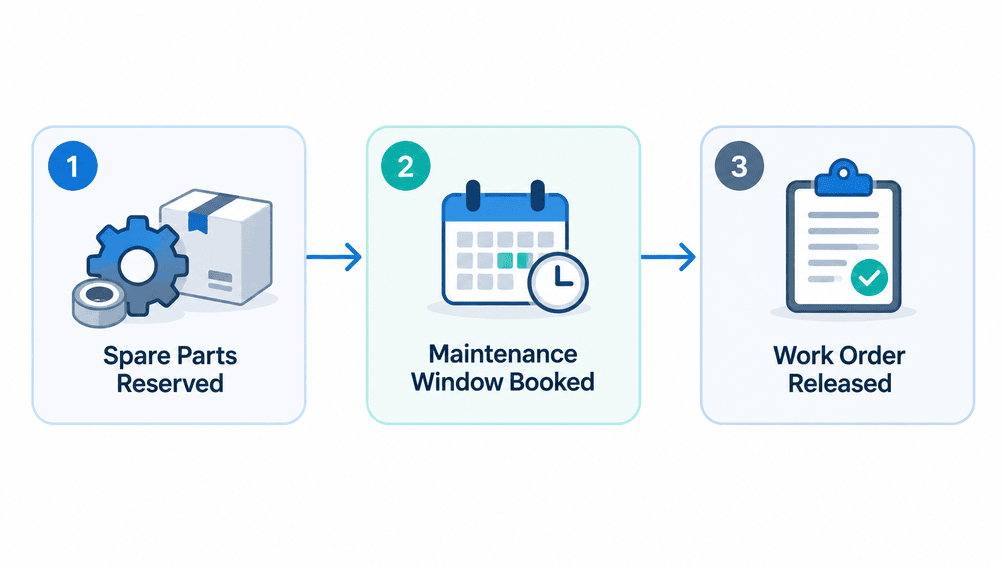
The sequence that avoids this runs in a fixed order: parts first, then window, then work order. Start from your failure history and list the parts each service is likely to consume. Reserve or order them against the due date, and treat supplier lead time as part of the schedule, so a bearing that takes six weeks to arrive means the service is planned six weeks before its window. Book the window only once the part is confirmed. Release the work order last. The order matters because a window booked before the part exists is a window you will cancel, and each cancellation teaches production that windows are negotiable.
Add a status called PM incomplete, which keeps the work order open until the work is done and the parts are fitted. Then count the orders closed with comments such as inspected, part to be ordered. That count is your early signal. In the same 2026 survey, 29% of leaders named parts shortages as a top cause of unplanned downtime, so this problem is common.
The tradeoff is working capital. Spares for critical, long-lead items tie up cash, so limit reservations to assets whose failure stops a line and leave the rest on ordinary procurement.
What to defer when the week falls apart
Even with protected windows, some weeks collapse. Two technicians are out, a press fails, and the schedule that looked sound on Monday cannot be met. Labour shortages were cited by 36% of leaders in that 2026 survey, so plan for the week rather than hoping it never comes.
Decide the deferral rules in a calm month, not on the day. Rank assets by what happens when they fail: those that stop production with no standby come last in line to be deferred. Separate task types too. Safety, lubrication, corrosion and environmental checks still matter on an idle machine, so they stay. A calendar-based service on a machine that has not run since the last one can wait, because an interval based on running hours would not have come due.
Then fix who decides. The planner proposes the deferral list, a production manager signs it, and every deferred service gets a new date, never later. Record a reason for each. After a quarter the reasons sort themselves into production access, parts, labour and nobody noticed, and the largest pile tells you which of the earlier fixes to apply first.
Where the ERP’s maintenance module is enough, and where it is not
Most ERPs include a maintenance module, and the honest question is whether your technicians will use it. These modules are often built first for recordkeeping, which is a different job from running the workshop, and low technician adoption is the usual complaint. Test yours on one real asset before you decide anything.
Ask three things. Can a technician close a work order from the floor, on a phone, in a couple of minutes, with the parts used recorded? When a due date moves, does the production plan show the change without someone re-keying it? Can you pull downtime hours, spares consumed and cost for one asset in a single view? If the answer to all three is yes, the module will serve most mid-sized plants. If the plant has many complex assets, or wants vibration and temperature monitoring feeding the schedule, a dedicated maintenance system integrated with the ERP is usually the better design, and the window and parts rules above still apply to it.
Once the rules are agreed, routine steps can run themselves: raising the next request when a service closes, flagging a missing part, releasing the order when stock arrives. We cover that idea in our piece on an ERP that acts instead of only reporting. Predictive monitoring is a later step than any of this, because sensor data has nothing to improve until the schedule is being followed.
Start with last quarter’s deferrals
Before your next planning meeting, pull every preventive service that was deferred last quarter and sort the list by reason: production access, parts, labour, nobody noticed. The biggest group tells you whether to start with the window policy, the parts sequence or the deferral rules, and it gives you a number to put in front of whoever owns the production plan.
If the biggest group is production access, the conversation you need is with the person who builds the schedule, and it has to happen before orders are booked rather than after the technician has been turned away. That one conversation is the cheapest maintenance investment most plants will make this year.