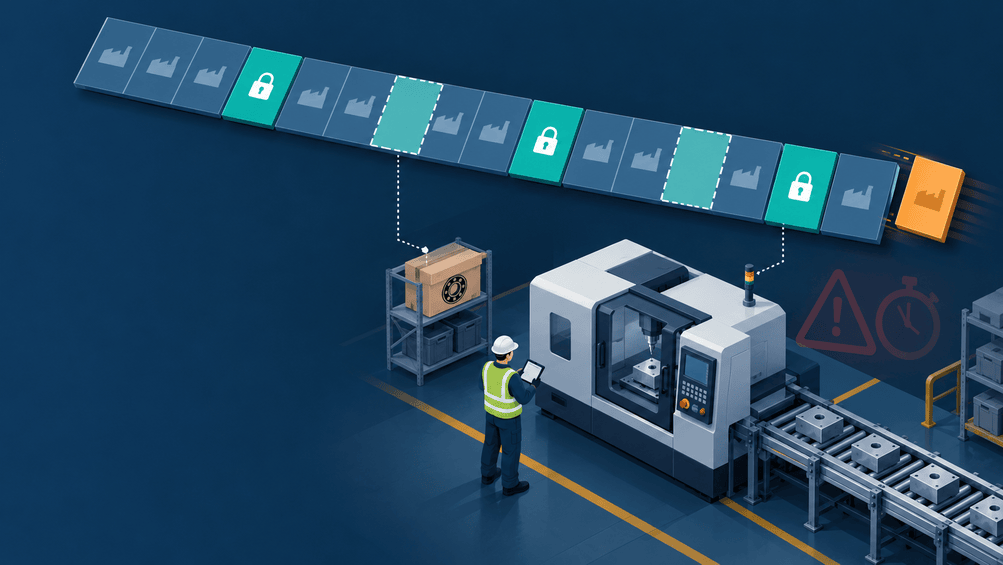

When a global manufacturer with a nine-figure IT budget takes fourteen months to go live on a new ERP system, and a mid-sized operation with a fraction of those resources does it in seven, the natural assumption is that the mid-sized company got lucky. Or cut corners. Or bought a simpler system that doesn’t really do as much.
None of those explanations hold up.
A 2026 analysis of cloud ERP deployments across hundreds of real go-lives found that mid-market manufacturers in the $100M to $250M revenue range averaged 6.7 months from project kick-off to go-live. Companies over $25 billion averaged 12.4 months. That gap isn’t driven by system complexity alone. It’s driven by something structural, something that no enterprise can buy its way out of, and something that mid-sized manufacturers are starting to recognise as a genuine competitive lever.
For C-suite leaders at mid-sized manufacturing businesses, this isn’t a feel-good statistic. It’s a strategic window.
Why Mid-Sized Manufacturers Go Live Faster
Mid-sized manufacturers implement ERP faster than enterprises because of how decisions get made, not how much money gets spent. Proximity between leadership, operations, and the teams doing the actual configuration creates alignment that enterprise projects spend months trying to manufacture through workshops, steering committees, and consultants. The companies going live in under nine months share one consistent characteristic: the people who understand the business and the people configuring the system are rarely more than one conversation apart.
That structural closeness is what compresses timelines. It’s available to every mid-sized manufacturer running a live project today. The question is whether leadership understands it well enough to protect it.
The Enterprise Paradox: More Resources, Slower Results
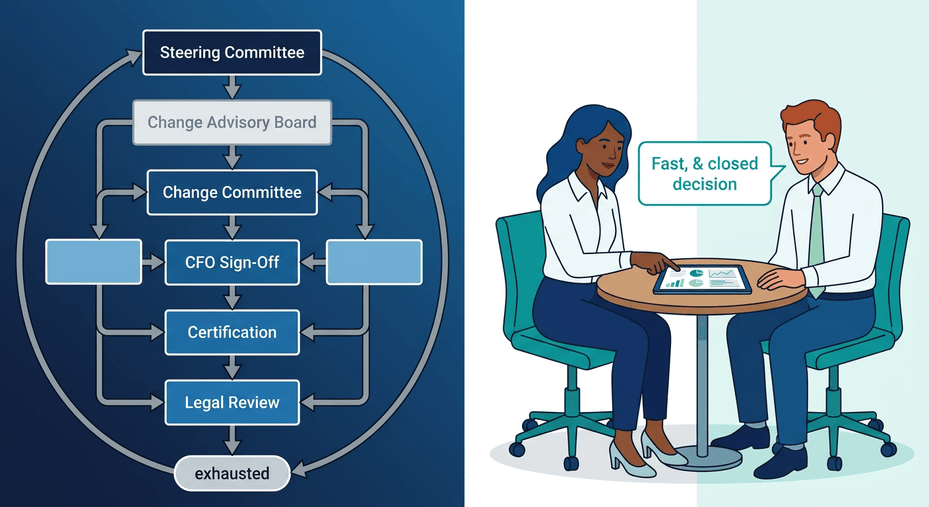
The assumption that bigger budgets produce faster outcomes is one of the most durable myths in enterprise technology. In ERP implementation, the opposite is consistently true.
Enterprise projects don’t fail because of poor software choices or inexperienced teams. They fail because of governance weight. A decision that takes a mid-sized operations director thirty minutes to make can take three months in a large enterprise: a steering committee review, a change advisory board, a CFO sign-off, a legal review of the vendor contract amendment. Each layer adds time. Each layer introduces the risk of misalignment between what the business actually needs and what the project team ends up building.
The data reflects this. Research covering discrete manufacturing ERP projects found that 73% fail to meet their original objectives, with cost overruns averaging 215%. The majority of those failures cluster in large enterprise environments, where the distance between decision-makers and execution teams creates a communications gap that consultants are paid to bridge, but rarely can.
There is also a user adoption dimension that rarely gets enough weight in the early planning conversations. Enterprise projects often reach go-live with technically configured systems and operationally alienated teams. People who were never consulted during design reject workflows that were built without them. As explored in why ERP user adoption is the number one reason implementations fail, the bigger the organisation, the wider that gap tends to be, and the harder it is to close after go-live.
Mid-sized manufacturers don’t have the governance overhead that creates those conditions. And that turns out to be an advantage that money can’t replicate.
What Mid-Sized Manufacturers Have That Enterprises Don’t
The structural advantage of a mid-sized manufacturer isn’t about headcount or budget. It’s about decision-making proximity.
In a manufacturing business with 300 to 1,000 employees, the COO who approved the ERP project can walk to the production floor in two minutes. The operations manager who knows where the inventory process breaks down is in the same building as the implementation team. When a configuration decision needs a call, that call happens today, not in two weeks when the relevant stakeholders can be assembled across four time zones.
This proximity compresses timelines at every stage. Requirements gathering that takes three months in an enterprise project takes three weeks when the right people are in the same room. Testing cycles that generate hundreds of open issues in a large organisation resolve quickly when the person who raised the issue and the person who can fix it are having coffee together.
It also changes the quality of what gets built. A factory with twenty years of institutional knowledge held by five senior operations staff can transfer that knowledge into system design in ways that no requirements document ever fully captures. The people who know where the edge cases live are available. They’re engaged. They have a personal stake in whether the system works.
That combination of institutional knowledge, decision proximity, and personal accountability is genuinely difficult to replicate at scale. In ERP implementation, it translates directly into months saved and failures avoided.
The Customisation Trap Enterprises Fall Into (And Mid-Sized Companies Can Avoid)
One of the most reliable predictors of a slow, expensive ERP implementation is the volume of customisation a project accumulates before go-live.
Research consistently shows that over 90% of organisations modify their ERP system beyond standard configuration. At the enterprise level, the drivers of that customisation are often not operational. They’re political. A division that doesn’t want to change its reporting format. A regional team insisting its procurement process is unique. A legacy integration that no one wants to own the decision to retire. Each exception adds scope. Scope adds time. Time adds cost. And the cumulative effect is a system that was supposed to simplify operations becoming a patchwork of modifications that requires specialist knowledge to maintain and is nearly impossible to upgrade cleanly.
Mid-sized manufacturers are not immune to this trap, but they are better positioned to avoid it. With flatter hierarchies and clearer ownership, it becomes possible to make the call that a workflow needs to change to fit the system, rather than the system needing to change to fit the workflow. That distinction is where most ERP value gets made or lost. As the evidence around ERP workflow design and why businesses quietly underperform their systems makes clear, a system running on clean, configured processes delivers value from day one. A system built on custom code starts depreciating before it’s live.
The manufacturers who go live in under nine months almost universally configure first and customise only where the business case is inescapable.
What Fast Actually Looks Like in Practice
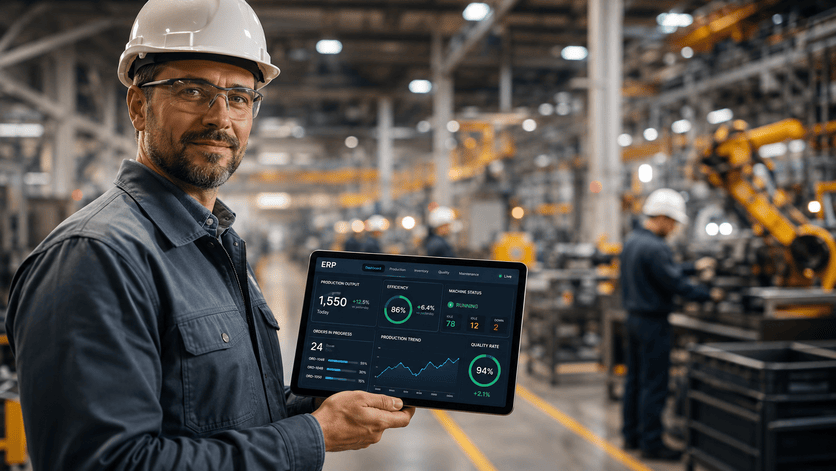
The speed advantage isn’t theoretical.
A 2025 analysis of 167 mid-market manufacturing ERP deployments found that the fastest cohort, those completing go-live within nine months using cloud-based platforms, shared three consistent characteristics. First, the project sponsor was an operational leader, not an IT function head. Second, the scope was fixed at sign-off and protected from expansion throughout. Third, data migration was treated as a business project, with operations teams owning data quality rather than outsourcing it entirely to the implementation partner.
Those three factors aren’t technology choices. They’re governance choices. And they’re available to any mid-sized manufacturer willing to treat implementation as a business transformation, not a software installation.
The economics have also shifted. A 2026 analysis of cloud ERP deployment patterns found that modern cloud-based platforms can reduce implementation costs by up to 50% and accelerate time to value by 40 to 60% compared to traditional on-premise approaches. For mid-sized manufacturers, this means the structural advantage of organisational closeness is now compounding with platform economics. The barrier to going live fast has never been lower for this segment, and the gap between those who move and those who wait is widening every quarter.
The Window Is Closing
The structural conditions that make mid-sized manufacturers faster at ERP implementation don’t last forever.
As companies grow, decision-making lengthens. New plants, new geographies, new business units, and new leadership layers all add the governance weight that currently slows enterprises down. The proximity advantage that a 500-person manufacturer holds today looks very different at 2,000 people. The speed that comes from having the right people in the same room erodes as headcount grows and reporting lines multiply.
This creates a strategic window, and for many mid-sized manufacturers it is already partway open. Those who build clean ERP foundations now, while they still have the organisational conditions to do it fast, will be operating on integrated, real-time systems while competitors are still in the planning phase. The argument for waiting, for feeling more ready, more resourced, more certain, rarely ages well. As the pattern of manufacturers who scale successfully before operational pressure arrives consistently shows, the companies that move early set the terms of competition. The ones that wait inherit the complexity their earlier hesitation created.
There is also a competitive dimension that compounds over time. Manufacturers operating on unified, real-time data make better production decisions, respond faster to supply chain disruption, and carry less inventory risk than those still stitching together disconnected systems. That operational edge doesn’t disappear when a competitor eventually goes live. It becomes a head start measured in operational maturity, not just months.
The Advantage Is Real. Use It Before It Disappears.
The ERP implementation gap between mid-sized manufacturers and enterprises isn’t going to close because enterprises get better at it. It exists because the structural conditions that drive implementation success, decision proximity, operational ownership, and a willingness to change processes rather than protect them, are fundamentally harder to preserve as organisations grow.
Mid-sized manufacturers have something enterprises spend years and millions trying to buy back: the ability to move fast with the right people in the room.
The manufacturers who recognise this and act on it will arrive at operational maturity faster, cleaner, and with less scar tissue than their larger competitors. Those who treat it as a future problem will find, by the time they’re ready, that they’ve grown into the very conditions that make enterprise implementation so difficult.
The window exists. The question every operations leader needs to answer is whether it’s still open for them.