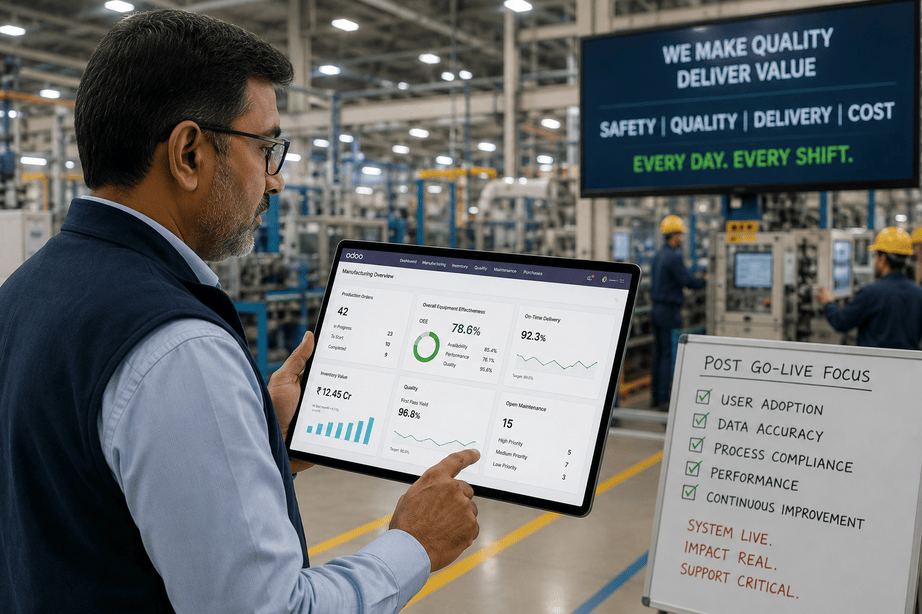
For most manufacturing CXOs, go-live feels like the summit. The project team celebrates, the implementation partner sends the final invoice, and the ERP that consumed a year of budget and attention finally switches on. Then the real test begins. Recent research on discrete manufacturing puts the failure rate for ERP projects at 73%, with cost overruns averaging around 215%. Read that number carefully, because most of those systems went live on schedule. They did not crash. They simply never delivered the return that justified the spend. That gap, between a system that runs and a system that pays, is where Odoo support after go-live earns its keep. The weeks that follow the launch decide whether your investment compounds or quietly stalls.
The Return Is Decided After the System Switches On
Here is the short version, because it is the part worth remembering: ERP ROI in manufacturing is not set at go-live, it is set in the six months after. A 2026 ERP industry report pegs the average return across projects near 52%, with payback around 16 months. Well-run mid-market manufacturers, by contrast, reach 150 to 250% ROI over three years. The same software sits underneath both outcomes. What separates them is what happens post-launch: how fast users adopt, how cleanly the system integrates with the shop floor, and how quickly early problems get fixed instead of worked around. Go-live starts the clock. It does not bank the value.
The Go-Live Illusion
Manufacturing leaders are trained to respect milestones. A line comes online, a plant hits capacity, a product ships. Go-live looks like one of those moments, and that resemblance is exactly the trap. A production line either works or it does not. An ERP can be fully live and still be leaking value on day one, invisibly, because the losses show up in behavior rather than in error logs.
Consider what actually changes the morning after launch. During implementation, the partner ran the show. They led the steering committees, owned the timeline, and absorbed the pressure. After go-live, that structure dissolves. The partner rolls off. Your project team, exhausted, returns to their day jobs. And the entire organization turns to your operations and IT leaders and asks a simple question: so what now?
Nobody plans for that question, yet it lands within the first week. The warehouse team hits an edge case the configuration never anticipated. A production supervisor finds the new work order screen slower than the spreadsheet it replaced. A finance lead notices a report that does not reconcile. Individually, these look minor. Collectively, they are the first cracks in your ROI, and they widen fast when no one owns them.
Where the ROI Actually Leaks
The money does not disappear in one dramatic failure. It drains through a hundred small ones, and almost all of them trace back to people rather than code.
Adoption is the biggest leak. When a system feels harder than the old way, people quietly revert. They keep the side spreadsheet, they batch their data entry for later, they ask a colleague instead of the system. A 2026 manufacturing ERP research analysis followed one 750-employee automotive supplier that skipped early stakeholder alignment: adoption stalled at 48% after go-live. Half the workforce, working around the system the company had just paid a fortune to install. A system used by half your people delivers a fraction of its promised return, and no amount of technical uptime fixes that. This is why user adoption is consistently the number one reason ERP investments fail, not licensing costs or feature gaps.
Reporting is the second leak. Manufacturing runs on trust in numbers. The moment a plant manager catches one inventory report that is wrong, they stop trusting all of them, and decisions drift back to gut feel and side calculations. Dirty data compounds this, which is why ERP data hygiene is a board-level issue rather than an IT chore.
Configuration drift is the third. The system was built for how the business operated during the project. But manufacturing does not stand still. New products, new suppliers, new compliance rules, and a configuration frozen at go-live slowly falls out of step with the operation it is supposed to run. Every gap between the system and reality is a manual workaround, and every workaround is margin quietly walking out the door.
Integration is the fourth, and it is where the largest returns hide. In manufacturing, the ERP rarely stands alone. It has to talk to the shop floor, to machine data, to quality systems, to whatever tools run production planning. Research on mid-market manufacturers is blunt on this point: integration is where real ROI is realized, and it is also where most projects underinvest. A finance module that runs beautifully but cannot see live production status is a very expensive ledger. The returns compound only when the system reflects what is actually happening on the floor, in something close to real time, rather than 48 hours after the fact.
The First 180 Days Are an ROI Engine, Not a Warranty Period
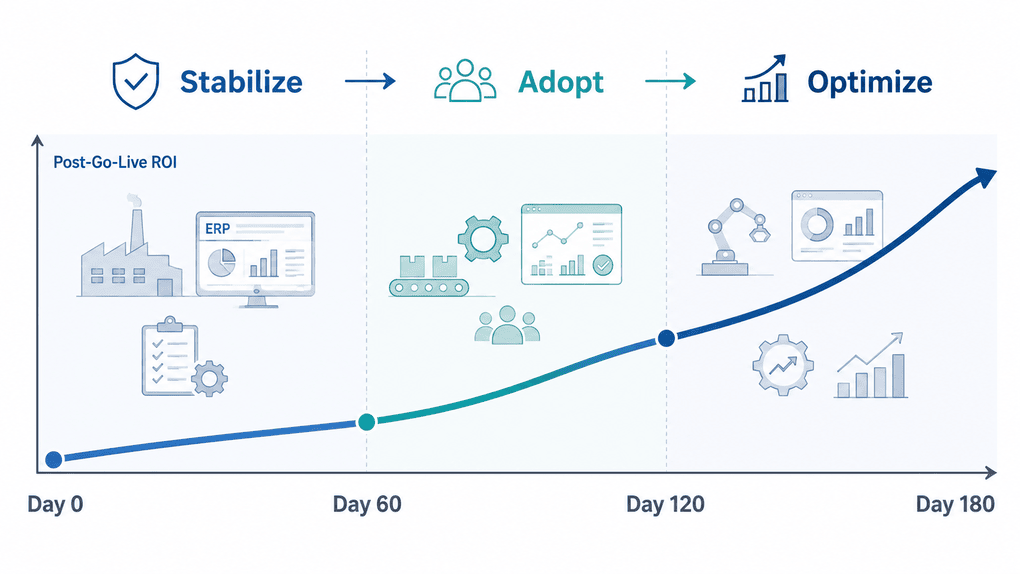
Most organizations treat post-go-live support as a safety net: something to call when the system breaks. That framing is why so much value is left on the table. The first six months are not a warranty period. They are the single highest-leverage window you will ever have to convert a live system into a profitable one.
The work moves through three gears. First, stabilize. In the earliest weeks, the job is to catch and fix the real-world issues that only surface once actual users are in the system under real production load. Speed matters here more than perfection, because every unresolved friction point trains people to distrust the system.
Second, drive adoption. This is where role-based enablement pays off. The same 2026 research analysis documented a mid-market manufacturer that cut training time by 40% by teaching people the specific workflows their job required, rather than drowning them in generic system tours. Focused enablement turns reluctant users into fluent ones, and fluency is what unlocks the efficiency gains the business case promised. It is worth remembering that a 2026 ERP report found 66% of organizations saw improved operational efficiency and 91% saw better inventory management after go-live. Those gains are not automatic. They belong to the companies that did the post-launch work.
Third, optimize. Once the system is stable and adopted, the conversation shifts from fixing to improving. This is where an ERP stops being a record-keeper and starts becoming an active control system that drives decisions in real time. Automations that were parked during the rush to launch get switched on. Reports that surfaced blind spots get built. Reorder points that were guessed at go-live get tuned against real demand. Subcontracting flows that lived in email start living in the system. Each of these is a small ROI increment, and stacked over months, they are what move a project from the average 52% return toward the 200% that well-run manufacturers achieve. The system starts giving back, and it keeps giving back as long as someone keeps improving it.
None of this happens by accident, and almost none of it happens without deliberate ownership. The organizations that capture it are the ones that budgeted for the work before go-live rather than discovering the need after.
What Post-Live Support Should Actually Look Like
If the first 180 days decide the return, then post-go-live support is not an expense to minimize. It is an investment to structure deliberately. For a manufacturing CXO, a few principles separate support that protects ROI from support that just answers tickets.
Continuity is the first. The people who supported you into the system should be people who understand how it was built, so you are not paying to re-explain your own operation every time something needs attention. Knowledge that walks out the door at go-live is knowledge you pay to rebuild.
Proactivity is the second. Good support does not wait for the system to break. It watches adoption rates, monitors data quality, and flags the edge cases before they become month-end fires. The best measure of post-live support is not response time on incidents, it is how few incidents reach you at all.
Business fluency is the third, and it is the one manufacturers underrate most. Support that understands your production reality, your BOMs, your subcontracting, your compliance load, solves problems in the language of your operation. Generic technical support fixes the symptom. Support that knows manufacturing fixes the cause. And in a sector where 73% of projects miss their objectives, that difference is the whole game.
The Real Question in Front of You
The uncomfortable truth is that your ERP does not know or care that it went live. It delivers exactly the return your organization is prepared to extract from it, no more. The companies pulling 200% returns and the ones stuck near break-even often bought comparable systems. What separated them was a decision made after launch, about whether the first six months would be treated as an ending or as the real beginning.
So the question is not whether your go-live succeeded. It is what your operation intends to do with the 180 days that follow. That window is open now, and it does not stay open long. The return on everything you have already spent depends less on the system you selected and far more on the deliberate, sustained work of turning it into something your people actually use, trust, and improve. That work is where the money is. The go-live was never the win. It was the starting line.