

Raw material cost has become the dominant worry on the shop floor. In a Q2 2026 survey, 83.1 percent of manufacturers named it their top business challenge, up from 57.5 percent a single quarter earlier. The instinct is to reprice, and quickly.
A July 2026 benchmarking study covering 456 manufacturing facilities found something more uncomfortable. Even when manufacturers do pass increases along, the timing gap erodes profitability in the interim. Repricing is a race, and most plants are running it a step behind.
That finding assumes something a lot of plants cannot actually support: that you know what the product costs. Repricing only protects margin if the number you price from is close to reality. In most mid-market operations that number is a standard cost set at some point last year, rolled forward since, and never reconciled against what the floor consumed. The margin is not being managed. An estimate is being managed, and it has been drifting quietly for months.
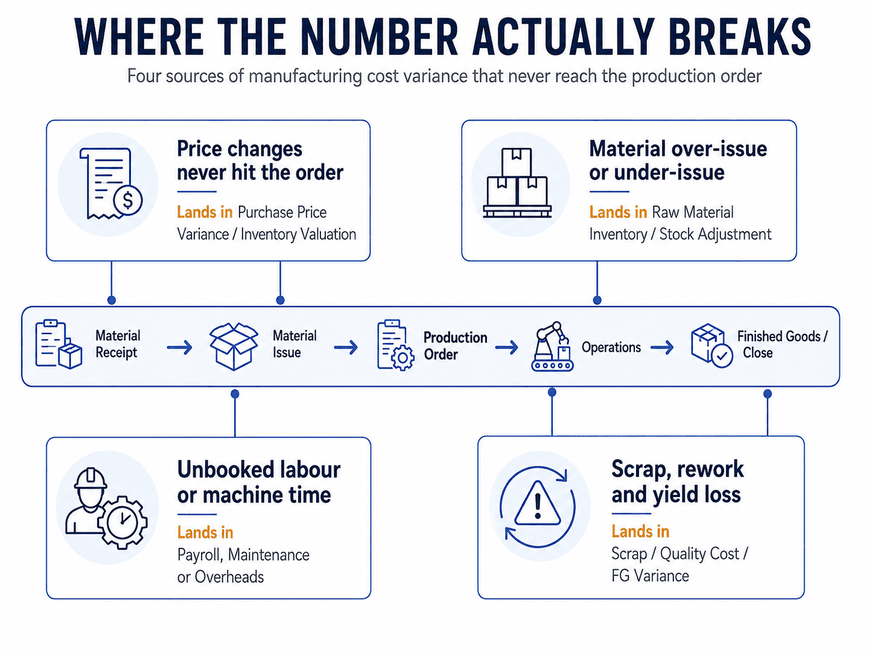
The standard cost is rarely wrong in one large, obvious place. It is wrong in four small ones, and they share a property that makes them hard to catch: in each case the loss gets booked somewhere that keeps it off the production order. Scrap and rework consume material and hours that never get charged back. Subcontract yield loss vanishes inside a vendor’s process. Machine time sits in the routing as an assumption nobody has measured since the item was created. By-product value gets credited to the wrong place. Individually, each is a rounding error. Together they are the gap between the margin you quoted and the margin you booked.
The Loss That Ships
Scrap is the honest failure. The part is discarded, the material is written off, and the loss shows up in the morning report where someone can see it.
Rework is the quiet one, and it is usually the more expensive of the two. A reworked unit eventually passes inspection and ships, so it looks like a save. What it actually consumed was extra labour, extra machine time, and capacity that could have produced new product. Because the unit ships as good, that consumption is almost never booked against quality or against the order that caused it. Recent cost-of-poor-quality analysis puts the real bill at three to five times the visible scrap cost, and notes that the first honest look at the numbers typically lands at two to four times what finance had reported. Scrap alone runs between 3 and 10 percent of total material cost in a lot of plants.
The mechanism is mundane. At completion, the operator books the good quantity. The reworked unit is inside that good quantity. The hours spent in the rework cell either go unrecorded or get absorbed into general indirect labour, where they inflate the overhead rate for every product instead of landing on the one that needed fixing. The diagnostic takes an afternoon. Pull your ten highest-volume orders from last quarter and compare units started against units completed. If the difference is not visible on the order itself, your rework is uncosted, and the products that generate the most rework are being subsidised by the products that generate none. The structural fix is to raise rework as a separate order linked to the parent, so the cost accumulates against the job that caused it rather than dissolving into the plant average.
Who Absorbs the Yield Loss
Send material out for plating, heat treatment, or machining and some of it will not come back. That is normal. What is not normal is that in most mid-market operations, nobody can say how much.
Under a typical tolling arrangement, title and risk of loss on that material stay with you. You still own it while it sits in someone else’s building. Well-drafted subcontracting agreements reflect this with three specific provisions: a target yield, a minimum guarantee, and a material accounting clause. Most mid-market purchase orders specify a price per piece and a delivery date, and nothing else.
Here is how the loss disappears. You issue 1,000 kilograms. You receive back parts equivalent to 940. The 60 kilogram difference is not reconciled at receipt, because receipt is checked against the piece count on the order rather than the material balance. It surfaces months later as an inventory adjustment, valued at standard, in a period that has nothing to do with the job that lost it. By then it is a stock discrepancy rather than a costing signal, and it gets written off as one. This is the same dynamic that makes inventory value quietly vanish inside subcontracted operations without anyone making a decision about it. Check last quarter’s subcontract receipts against quantity issued at your assumed yield. If you have no assumed yield on record, that is the finding.
Check last quarter’s subcontract receipts against quantity issued at your assumed yield. If you have no assumed yield on record, that is the finding.
Measured or Inherited
Every routing carries a time. Very few carry a time anyone has measured recently.
Routing times are usually set when the item is created, estimated by whoever set it up, and sometimes copied from a similar part to save effort. Then tooling changes, a machine ages, a cycle gets adjusted for a quality problem, an operator finds a faster sequence. The routing stays where it was. Labour and machine efficiency variance is the most sensitive of all the variances to this drift, because it compounds across every unit. A standard of 0.75 hours against an actual of 0.92 is a 23 percent error on the largest controllable element of conversion cost, and at volume it is a serious number.
The tell is easy to check. Pull the routing times on your ten highest-volume items and look at the last-modified date. Then ask when you last changed tooling, cycle, or process on those items. If the process has moved and the routing has not, the time in your cost card is inherited rather than measured, and every quote built on it carries the same error. Plants that work through this exercise usually discover they have been running below the capacity they already paid for, because the assumed cycle times were never the real constraint.
The Credit in the Wrong Column
Processes that yield a secondary saleable output force a choice most plants make once, by default, and never revisit. By-product revenue can be recognised as other income, or it can be netted against the joint cost pool before costs are allocated to the main products.
The two treatments produce genuinely different product margins, which means they produce different pricing decisions. Netting reduces the cost allocated to the main output and makes it look more profitable. Recognising it as other income leaves main product margins untouched and parks the value outside operations entirely, where it never informs a quote.
The failure mode worth knowing is the third option, where a secondary output is treated as a full product and made to carry its share of joint cost. That can produce a negative gross margin on something you sell profitably, and the apparent conclusion is that you should throw the material away instead of selling it. Anyone who has seen that report knows the number is wrong without being able to say why. There is a real tradeoff here. Other income is simpler and perfectly defensible when the value is immaterial. Netting is more accurate for pricing but adds a monthly allocation step someone has to own. Choose deliberately, document which one you chose, and make sure you know which order the credit lands on.
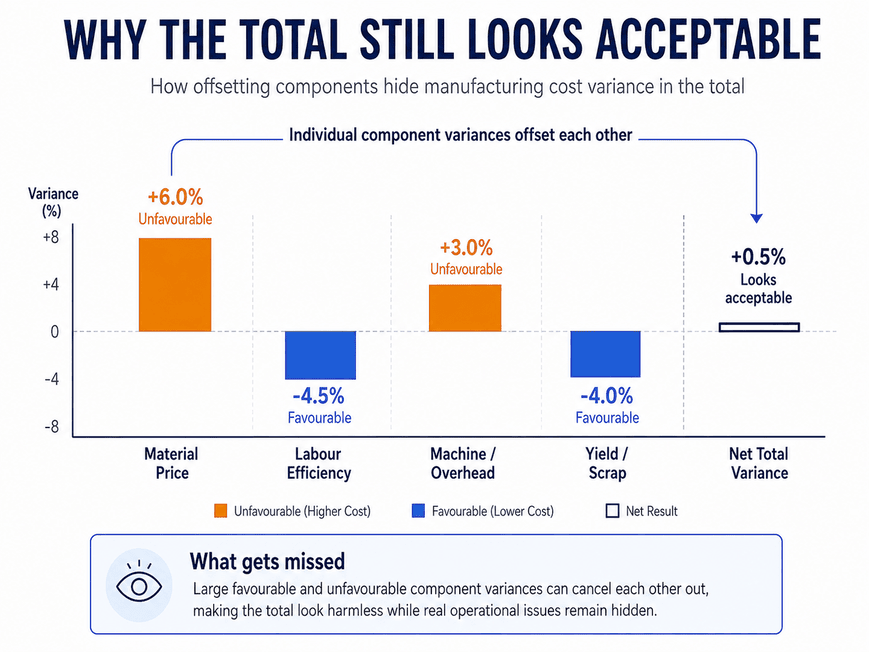
All four of these can run simultaneously while your variance report looks unremarkable. That is the part that catches people.
A single total cost variance masks offsetting components. A favourable purchase price variance from one good buy on steel will absorb an unfavourable usage variance from a month of heavy scrap. The net lands inside tolerance, nothing gets flagged, and nobody investigates. Stopping at the aggregate number is the most reliable way to miss all four leaks at once, because the aggregate is precisely where they cancel each other out. Review at the component level, every month, or the report will keep reassuring you.
Make It a Rhythm, Not an Audit
Variance review in most mid-market plants is an annual event. It happens when the auditors ask, or when someone notices a product line has been losing money for three quarters. By then the standard has drifted so far that the reconciliation becomes a project, which is exactly why it keeps getting deferred.
The alternative is unglamorous. Once a month, at component level, with an operations person and a finance person in the same room, working through the variances that fell outside tolerance and naming a cause for each. Not every variance needs an action. Every variance needs an owner who can explain it.
Plants that hold that meeting stop being surprised. Their standards stay close enough to actual that repricing is a calculation rather than a guess, and their quotes reflect what production genuinely costs rather than what it cost in a period nobody remembers. That is the difference between a factory that predicts its results and one that records them after the margin has already gone.
The number that sets your pricing deserves the same monthly attention you give the numbers that measure your output. Right now, in most plants, it gets a fraction of it.