
MRP has a known accuracy threshold. Your bill of materials, your inventory records and your master schedule each need to be more than 95% accurate. Below that, the output is not safe to act on without review. A 2026 manufacturing planning reference calls this the minimum standard before go-live. Very few plants hit it. Fewer still check.
You do not need an audit to find your real number. Your planners already know it. Every Monday they open the action messages. They change eleven dates before the production meeting starts. They tell nobody why.
That change rate is a live accuracy score. It comes from the people closest to the data. And it is the only measurement in your plant that nobody records.
Planners override MRP for one reason. MRP models structure. Your plant runs on behaviour. The system knows a lead time, a lot size, a safety stock level and a routing. It does not know that one supplier slips every quarter-end. It does not know the second shift refuses a changeover on Friday evening. It does not know which customer always pulls back the order they just pushed out. Your planner knows all of this. There is no field for any of it. So they put it in the date instead. The override is the gap between the model and the plant.
The Override Is Free Data. You Delete It Every Week.
Every override says two things. The recommendation was wrong. And here is why.
Your system records the first and throws away the second. So the same wrong recommendation comes back next cycle. And the cycle after that. You pay for the correction every week. You never buy the fix.
A 2026 survey of 230 supply chain leaders found that manual adjustments and spreadsheets still sit at the centre of planning. It also found that two planners in similar situations often decide differently. That variation is not the real problem. The real problem is that neither decision leaves a trace. So a plant collects thirty years of planning experience and zero years of planning improvement.
The fix is smaller than most operations leaders expect. Put a reason code on every override. Five options. No free text.
- Material showed as available but was not there
- The date cannot be met on the floor
- The supplier will not hold the quoted date
- The quantity ignores a tooling, batch or container constraint
- Demand information exists that the system never received
Thirty seconds per override. Then change nothing for four weeks. You will want to start fixing things in week one. Resist it. Fixing early means guessing again, which is what the overrides were already covering up.
One thing to check first. If your planners keep a private workbook next to the system, you already have a reason log. It just sits where nobody else can read it. Look there before you build anything, because the parallel spreadsheet quietly running your factory usually holds the logic your setup is missing.
Three Overrides That Look The Same and Mean Different Things
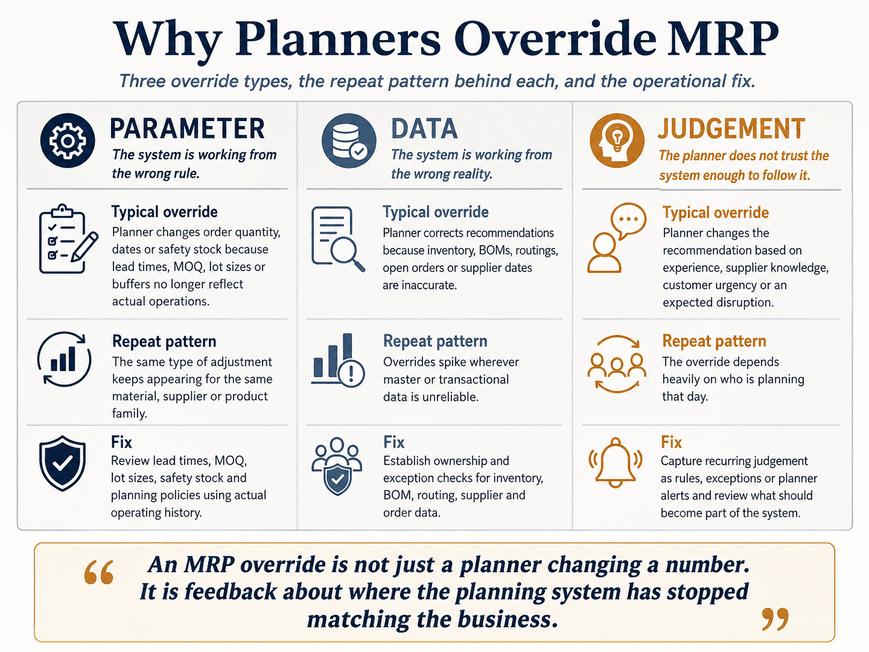
After four weeks, sort the log two ways. Sort by item. Then sort by field. Whichever one clusters first tells you what you are dealing with.
A parameter override repeats on the same item every cycle, always in the same direction. The planner adds six days to the same part, week after week. The data is fine. One number in the item master is wrong, and someone has been quietly correcting it since go-live.
A data override repeats across many items but always hits the same field. Stock on hand is too high. A receipt was never booked. A scrap entry never went in. Re-tuning safety stock here does nothing. The parameter was never the issue. The timing was. Goods land on Tuesday and get booked on Thursday, so your system is describing a factory that existed two days ago.
A judgement override does not repeat. It comes from a supplier relationship, a customer habit, a sequence someone agreed with the floor. This is real expertise. It is also the worst thing to automate. Capture it and make it visible. Do not turn it into a rule, because the rule will be wrong when conditions change.
Most data cleanup projects fail here. They treat all three as one problem and buy one fix. Sorting first costs you a spreadsheet and an afternoon.
The Lead Time Number Nobody Owns
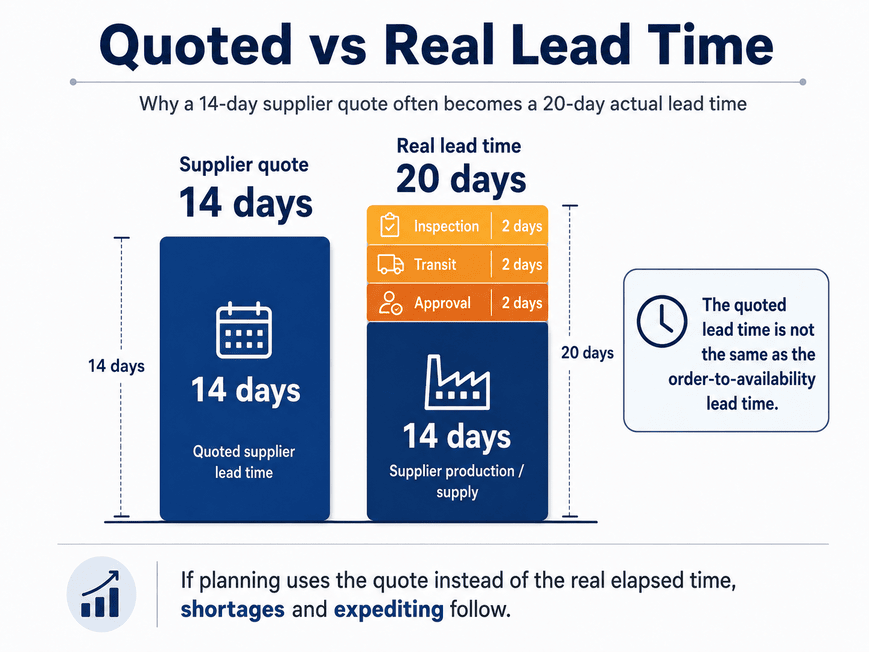
Parameter overrides are the most common of the three. Lead time is the field they usually land on.
Real lead time is not the supplier quote. It is the quote plus internal approval plus transit plus inbound inspection. A 2026 industrial procurement playbook runs the numbers. A supplier quotes 14 days. Internal approval takes four. Receiving takes two more to log the part. Actual lead time is 20 days. MRP plans to 14, because 14 is what sits in the field. Your planner adds six days by hand, every week, forever. It never shows up in a report.
The cost lands somewhere else. When the buffer is missing from the plan, you buy recovery instead. A 2026 supplier lead time analysis puts expedited freight premiums at 20% to 40% of spend, depending on distance and carrier. That is what one wrong number costs.
Here is a fast ownership test. Open the item master. Check your twenty highest-value purchased parts. Look at who last changed the lead time, and when. If the name is the implementation team and the date is your go-live year, nobody owns that number. It is not maintained. It is not reviewed. Nobody who uses it daily trusts it. This is why data hygiene in core business systems is a board-level issue. Fields like this one set the cash position of the whole plant.
The gain from fixing it is measurable. Ag Leader, an agricultural equipment maker, took on-time delivery from 76% to 99% and cut inventory by 32%. According to a 2026 account, the change was making supplier commitment dates visible and current inside the workflow where buyers already work. The plan started holding the date the supplier would actually meet. The planners stopped correcting for it.
Firming Orders Buys Stability. Here Is What It Costs.
The usual answer to constant rescheduling is a time fence and firm planned orders. It works. Inside the fence the near-term schedule stops moving. Purchasing and production stop getting contradictory instructions three times a week.
The tradeoff is rarely said out loud. Inside the fence, the system also goes deaf. A real customer pull-in, a supplier failure, a scrap event: none of it reaches the plan. You did not remove the noise. You muted the channel that carried the noise and the signal together.
So keep the rule narrow. Firm an order to protect something physical that already happened. Material cut. Tooling set. A sequence agreed with the supervisor. Never firm an order to protect a parameter you have not fixed. The first is planning. The second is hiding, and it grows, because the buffer stays invisible while everyone downstream plans as if it is not there.
Two signs tell you the fence has become a hiding place. Your firm order count climbs month over month instead of staying flat. And firmed orders almost never get unfirmed, which means nobody was managing them. They were just taken off the screen.
What Changes When the Override Feeds Back
The operating change is one 45 minute review a month, with the planners in the room. Read the reason code counts. Pick the top three repeating codes. For each one, change the parameter or change the transaction step behind it. Write down which you changed. Next month, check whether that code dropped.
Total override count is the wrong metric. A plant with zero overrides has planners who stopped reading the plan. That is worse than a plant with forty. The right metric is whether a named code falls after a named fix. That is the difference between a planning function that learns and one that just absorbs the same friction forever.
This works best when the correction and the plan sit in the same place. Then the buyer, the planner and the supervisor look at one record instead of three versions of it. When the reasoning lives in a side file, the loop is broken by design. The plant ends up making decisions on data that is already 48 hours old while believing it is current.
The planner adding six days to that part has been running a free correction service for years. He knows which supplier slips in March. He knows which line will not take a changeover before a long weekend. He knows which customer forecast to cut by a third. None of it is written down. In most Indian manufacturing operations, that knowledge sits with people who are within a decade of retirement. It leaves with them.
Your override log is the only place that expertise gets recorded. Right now you overwrite it every Monday morning. So the question for your team this week is not how to cut overrides. It is harder than that. How much of next month’s plan exists only inside one person’s head, and what happens to the plan on the first Monday after they are gone?