
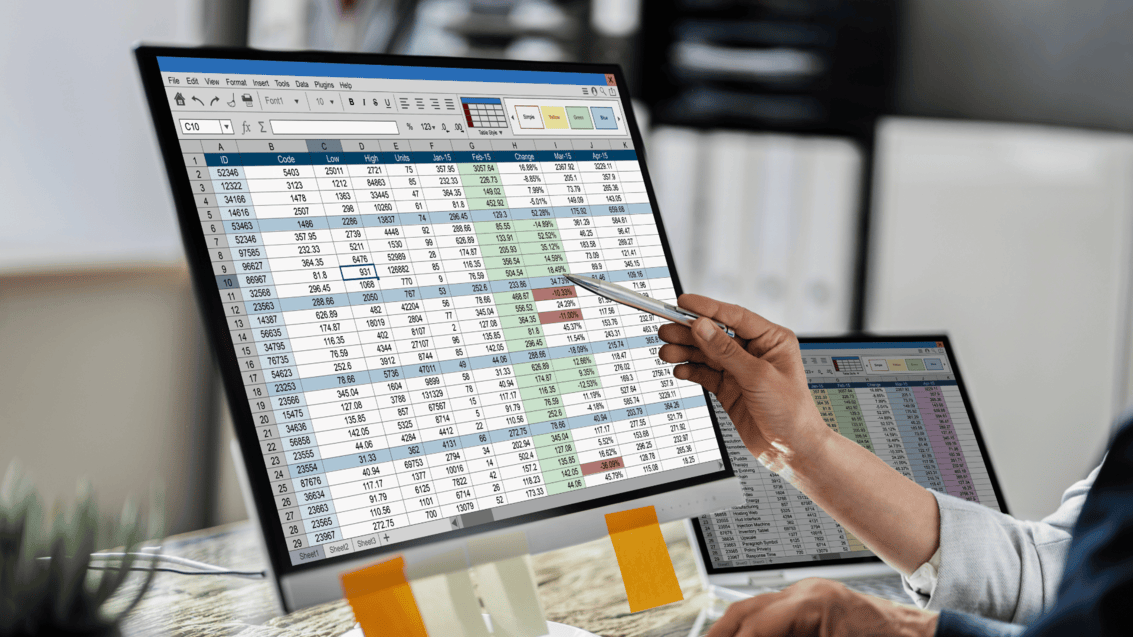
It never arrived as a decision. One spreadsheet tracked inventory because the old register was a mess. Another held the production schedule because it was faster than a whiteboard. A third reconciled supplier payments because the accounting software could not handle the way your shop floor actually works. Years later, your entire operation runs on a web of linked files that no single person fully understands. If you have quietly outgrown spreadsheets without ever choosing to, you are not behind. You are normal. Most growing manufacturers operate exactly this way. The problem is not that spreadsheets are bad. The problem is that they were never built to be the system of record for a company with real customers, real inventory, and real money moving every day. The cost of pretending otherwise is higher than most owners think.
So what does it actually cost to run a factory on spreadsheets, and is the fix really a massive software project? The cost shows up in four places: errors from competing file versions, total dependence on the one person who built the sheets, no reliable record of who changed what, and decisions made on numbers that were already stale when you opened the file. Together these quietly drain senior time and erode margins. The fix is not a year-long enterprise rollout. It is a gradual migration that absorbs one workflow at a time, starting with the one that hurts most.
The Four Invisible Taxes You Already Pay
Version-control errors come first because they are the most familiar. You know the moment: two people edited the inventory file the same afternoon, and now there are two truths. Someone reorders stock you already have, or skips a part you actually need. A 2025 finance survey found that 94% of teams still use spreadsheets during their month-end close, and those same teams routinely lose hours hunting for which copy is correct. On a shop floor, a wrong copy does not just waste time. It stops a line.
The second tax is single-person dependency. Every spreadsheet empire has an architect, the person who built the formulas and knows why one hidden cell feeds the production plan. When that person is on leave, off sick, or resigns, the knowledge walks out with them. You are not running a system. You are running a person, and a person cannot be backed up.
The third tax is the missing audit trail. When a number changes in a file, there is no reliable record of who changed it, when, or why. For a manufacturer dealing with GST filings, a supplier dispute, or a quality recall, that gap turns a five-minute question into a two-day investigation. Slowly, you stop fully trusting your own numbers.
The fourth tax is the quietest and the most expensive: decisions made on stale data. By the time a report is compiled, emailed, and opened, the situation on the floor has already moved. You are steering by a photograph of where the road was, not where it is now.
The Reconciliation Tax on Your Most Expensive People
Here is the cost that rarely makes it onto any budget line. Your most experienced people, the finance manager, the operations head, sometimes you, spend a startling share of the week simply assembling numbers instead of acting on them. A recent operations survey found that finance teams spend around 41% of their time gathering and processing data rather than analyzing it. Read that again. Nearly half the time of your most expensive staff goes to work that produces no decision, no improvement, and no growth.
Put a number on it for your own business. Suppose a senior finance or operations person costs you ₹15 lakh a year once you include salary, benefits, and the overhead of their seat. If 40% of their time disappears into reconciliation and report-building, that is roughly ₹6 lakh a year spent on data plumbing. Then add the owner’s own hours, the most valuable in the building and the hardest to recover. The spreadsheet empire never sends you an invoice. It just takes a cut of every senior salary, every month, forever.
Why the Big ERP Project Is the Wrong Reflex
So why do most owners keep paying these taxes instead of fixing the problem? Because the alternative, as it is usually sold, sounds worse. The phrase enterprise software conjures an eighteen-month project, a seven-figure budget, an army of consultants, and a real chance the whole thing fails and takes the year with it. That fear is rational. Plenty of large rollouts have collapsed in exactly that way.
But the fear is now badly out of date. The market has changed underneath the reputation. Cloud-based operational software for small manufacturers now starts at roughly the price of a mobile plan per user each month, and the better options are built to be switched on one module at a time. You are no longer choosing between two extremes: limping along on spreadsheets, or betting the company on a giant migration. That binary was real a decade ago. Today it is a myth, and it is quietly costing the owners who still believe it.
The deeper mistake is treating the move as a single, terrifying event. It is not an event. It is a sequence.
The Modular Path: Absorb One Workflow at a Time
Think of it the way you already think about replacing aging machines. You do not shut the whole plant to swap everything at once. You replace the bottleneck first, prove it works, then move to the next. Software migration behaves the same way when you let it.
Start with the single workflow that causes the most pain and the most reconciliation. For many shops that is inventory, because it touches purchasing, production, and cash all at once. Move only that into a proper system. Let it run alongside your spreadsheets for a cycle or two. Once the team trusts it, retire the spreadsheet that used to hold that data and move to the next workflow: production scheduling, then job costing, then supplier payments. Each step is small enough to absorb without stopping the line, and each one removes a tax you were quietly paying.
How do you pick the first workflow? Look for the one that combines two things: it eats the most senior time, and it triggers the most downstream errors. That is usually where a small win creates the most visible relief, which matters more than it sounds. The real obstacle to migration is rarely technical. It is trust. Your team has been burned before by tools that promised to help and only added work. So the first module has one job beyond its features: to prove that the new way is less effort than the old way. Get that right, and the rest of the migration starts to sell itself.
Owners also tend to overestimate the data migration itself, imagining that years of spreadsheet history must be transferred perfectly. In practice you move only what the business will use soon, open balances, current stock, active jobs, and archive the rest. The transfer is smaller and faster than the dread around it suggests.
This is not theory. Consider Vanquish Hardware Protection, a manufacturer that replaced its spreadsheets and basic accounting workarounds with a modular production system. In its first year after going live, the company grew revenue by 25% while adding only one or two new employees. That growth did not come from working harder. It came from removing the manual drag that capped how much the existing team could handle. A composites manufacturer, Light Composites, took a similar path and reached 97 to 98% inventory accuracy, all but eliminating the stockouts that used to interrupt production. Neither ran a doomed megaproject. They moved one workflow at a time and let the results compound.
The Empire Came One Spreadsheet at a Time
The spreadsheets are not the enemy. They got you here, and that deserves respect. But the file that started as a clever shortcut has quietly promoted itself to head of operations, and it is the one employee you can never train, back up, or hold accountable. The question is not whether you can afford to move off it. You are already paying for it, in senior hours, in stale decisions, and in the growth you cannot reach because your best people are buried in reconciliation.
The real question is smaller, and far less frightening, than the one you have been avoiding. Not how do I replace everything, but which single workflow do I move first. Pick the one that hurts most. Prove it. Then pick the next. The empire was built one spreadsheet at a time. You can dismantle it the same way.