Most supply chain leaders trust their inventory numbers more than they should. In a recent global survey of supply chain executives, 93% said they had high confidence in their oversight, yet only 56% could actually trace their materials down to their deepest supplier tiers. That gap between confidence and reality is where inventory accuracy quietly breaks. It rarely announces itself. It shows up as a stockout on a product the system swore was in stock, a rush shipment that should never have been needed, or a quarter-end count that refuses to match the ledger. For a C-suite that runs on data, the uncomfortable truth is this: your inventory record is only as accurate as the instant you captured the last movement. Everything downstream inherits that moment, for better or worse.
The Real Answer Is About Timing, Not Tools
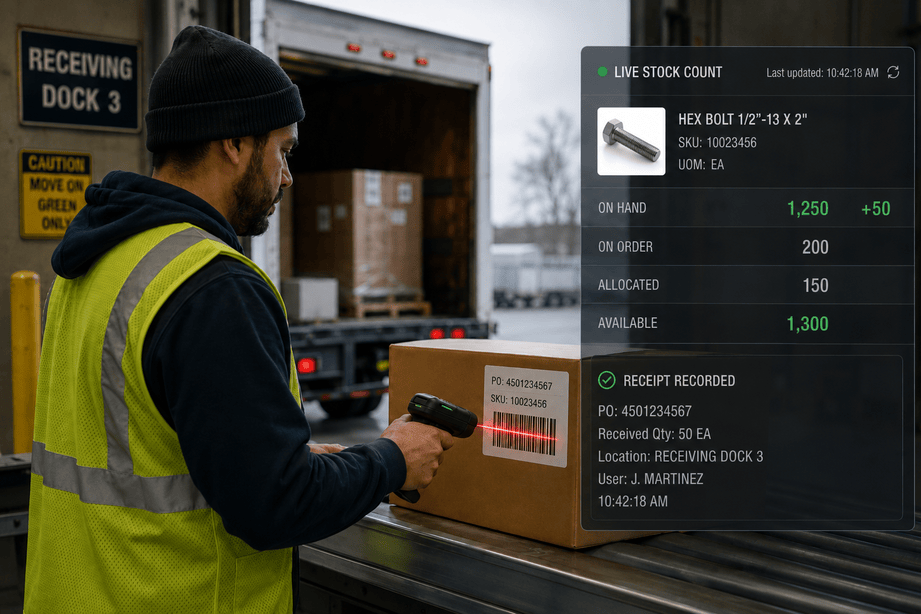
Stock accuracy is not created in the dashboard. It is created at the moment of movement: the second a pallet is received, a bin is picked, a carton is packed, a unit is shipped. If that movement is captured the instant it happens, your record stays true. If it is captured hours later in a batch, or typed in from memory, the record drifts. This is why inventory accuracy depends far less on how sophisticated your reporting looks and far more on how close your data capture sits to the physical event. Speed of capture, not speed of reporting, decides the truth.
The Overconfidence Gap
Walk any warehouse floor and you will hear managers describe their operation as running at 99% accuracy or better. The research tells a different story. Studies of inventory record inaccuracy consistently find that a large share of records are wrong in one direction or the other, and some 2026 retail analyses put the proportion of inaccurate records as high as 60%. One 2026 research paper on grocery environments found that only about a third of inventory records were exactly correct, with the rest spread across meaningful over- and under-statements of stock.
The reason this persists is that inaccuracy hides. A record that says 50 units when the shelf holds zero does not trigger an alarm. It triggers a phantom sale, a disappointed customer, and a support ticket days later. This phenomenon, often called phantom inventory, is the single most expensive lie a system can tell, because every downstream decision treats it as fact. Purchasing orders against it. Fulfillment promises against it. Finance closes the books against it.
Confidence, in other words, is not the same as accuracy. The two can move in opposite directions, and often do. When a team believes its numbers, it stops checking them, and unverified numbers decay. This is why the overconfidence gap is most dangerous at the executive level: the higher you sit, the more abstracted your view of inventory becomes, and the more you rely on a single figure that may have drifted far from the shelf it is supposed to describe.
The Latency Tax
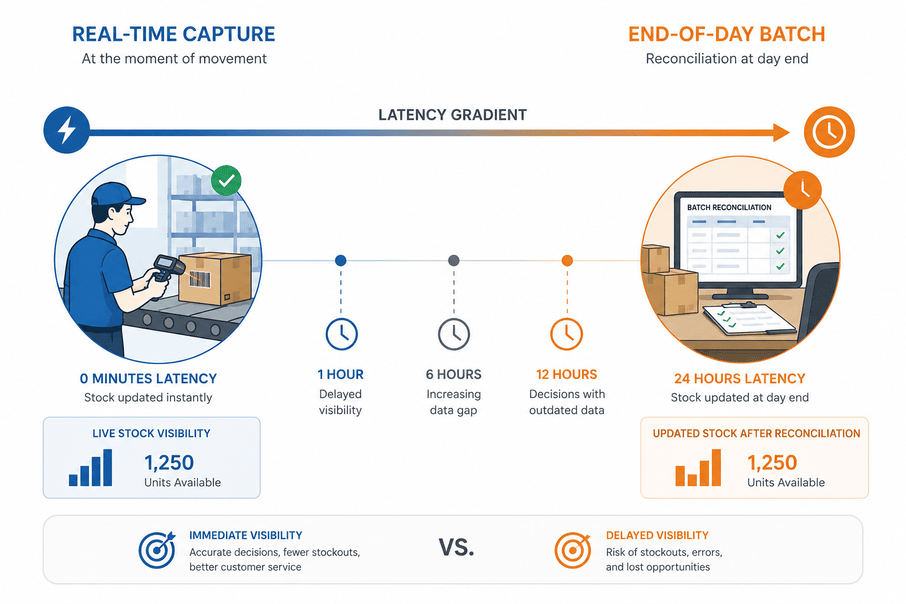
Every inventory system sits somewhere on a latency gradient. At one end, a movement updates the record the instant it happens. At the other, movements pile up and get reconciled at the end of a shift, a day, or a week. The distance between the physical event and the digital record is a tax, and it is paid in bad decisions.
Consider what happens when a distribution center runs on data that is already a day or two old. A planner reorders stock that is actually sitting in a staging area. A sales rep promises a delivery date the warehouse cannot meet. A finance team closes the month on a figure that a physical count will later contradict. None of these people are careless. They are acting on information that was true yesterday and is not true now. This is the same problem behind factories making decisions on data that is already 48 hours old: the data is not wrong because someone lied, it is wrong because it aged.
Here is the part most technology conversations miss. A reporting layer, an analytics dashboard, even an AI forecasting model cannot repair accuracy that was never captured cleanly in the first place. As one 2026 practitioner guide put it, a unification layer can reconcile and present, but it cannot invent accuracy that was never captured. A predictive model trained on drifted stock positions simply predicts drifted positions with more confidence, which is worse than an obviously unreliable number, because now it is trusted and automated in the place where a skeptical human used to sit. Latency does not just delay the truth. It compounds the error.
Why the Scan at the Point of Movement Changes the Math
This is where the humble barcode does something no dashboard can. It moves the point of data capture to the exact instant of physical movement, and it removes the human keyboard from the loop.
The accuracy difference is not marginal. A widely cited accuracy study found that a trained data-entry operator averages roughly one error per 300 keystrokes, while a common barcode symbology fails as little as once per 2.8 million scans. That is not an incremental gain. It is a different order of reliability. When a worker scans a product at receiving, scans the location at putaway, scans again at picking, and scans once more at packing, each handoff writes a verified event to the record in real time. The system stops matching someone’s memory and starts matching the shelf.
This is the logic behind Odoo inventory and barcode capture. Rather than treating the barcode as a labeling convenience, it uses the scan as the trigger for the inventory transaction itself. A scan at receiving marks goods as received and makes them available to sell or build. A scan at picking decrements stock the moment the unit leaves the bin. Because each scan is the transaction, the record updates at the speed of the physical event, not at the speed of a nightly sync. Order fulfillment accuracy in operations running a real-time warehouse system has been measured at around 99.5%, compared with roughly 92% in operations without one. That gap is almost entirely a function of when, and how, each movement was captured. It is also what turns an ERP from a system that records history into an active control system rather than a passive dashboard.
Inventory Accuracy as a Board Number
For the C-suite, this stops being a warehouse metric and becomes a financial one. Inventory is working capital. Every unit the system cannot locate is cash frozen in place, and every phantom unit is a sale promised and lost. Inventory distortion, the combined cost of running out of some items while drowning in others, is estimated to cost the global retail sector on the order of $1.7 trillion a year. That figure does not come from a shortage of stock. It comes from a shortage of truth about where the stock actually is.
Accurate, real-time capture changes what the rest of the business can do. Forecasting models built on live movement velocity see the weekend spikes and regional surges that monthly summaries smooth away. Replenishment triggers fire against real positions instead of stale ones. And when every function reads from and writes to the same continuously updated record, the internal argument about whose number is correct simply disappears. That single, trusted view is what it means to own the truth inside your organization.
The shift is already visible at the top of the industry. At the World Retail Congress in 2026, senior executives from major global retailers, including Target, Marks & Spencer, and Pandora, converged on a single conclusion: operational technology has to deliver measurable execution improvements, not just better-looking dashboards. The industry, they agreed, has moved past the insights phase and into the action phase. That distinction is the whole argument. In a 2025 field study across retail stores, an approach that flagged discrepancies the moment they appeared surfaced 90% more hidden stockouts than comparable stores that relied on periodic counts. Acting in the moment beats reporting after the fact, and the difference is measured in recovered revenue.
The Standard That Actually Matters
The question for a supply chain leader is no longer whether to invest in visibility. It is whether your data is true at the exact moment you need it, every time. That standard is unforgiving, and it is the right one. A number that was accurate this morning and wrong by lunchtime is not an asset. It is a liability wearing the costume of certainty.
The organizations that pull ahead over the next decade will not be the ones with the most expensive systems or the most elaborate reports. They will be the ones that closed the distance between the physical movement and the digital record until it effectively disappeared. Start where the pain is sharpest: your most mobile inventory, your most frequent stockouts, your most complex location. Capture the movement the instant it happens, and accuracy stops being something you audit once a quarter and starts being something you simply have.