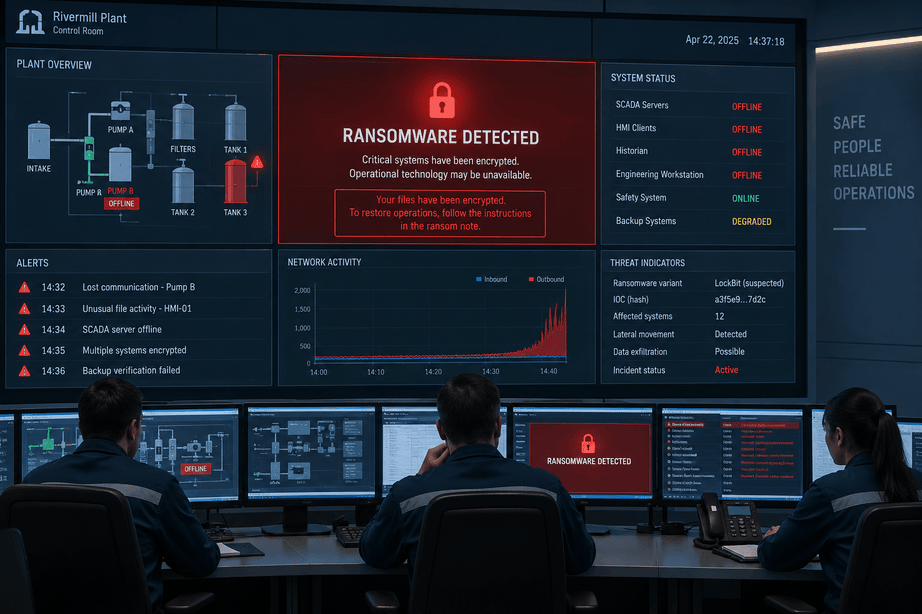
In early 2026, two of India’s largest industrial groups announced a ₹7,500 crore partnership to build fully autonomous, AI-powered factory floors by 2030. The headline is a glimpse of where manufacturing is heading. It also hides an uncomfortable truth for everyone else. Most factories today cannot see what is happening on their own shop floor in real time, let alone run it without a human touching it. A recent survey of manufacturing leaders found that roughly 7 in 10 still collect shop floor data by hand. The production plan lives in one system. The machines run in another. And the gap between them, the layer where planning is supposed to meet execution, is where money quietly leaks out. This is the real starting line for Odoo manufacturing and any serious conversation about a real-time shop floor: not autonomy, but a closed loop between the plan and the line.
What a real-time execution layer actually means
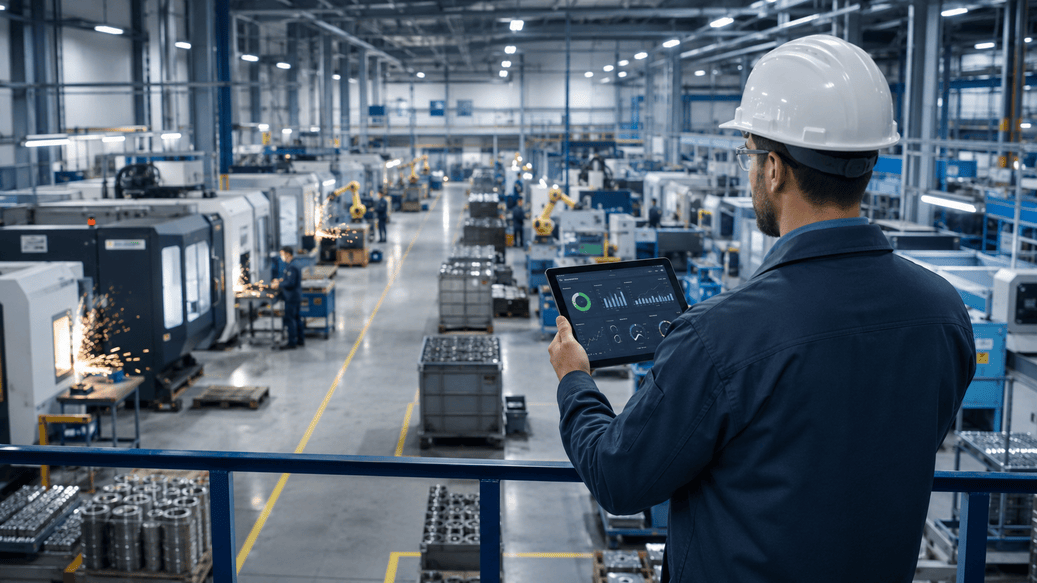
So what does it mean to turn the shop floor into a real-time execution layer? In the language of the ISA-95 standard, it means building the operations management layer that sits between enterprise planning, your ERP and MRP run, and process control, the PLCs and machines on the floor. MRP explodes a sales order into a schedule against your multi-level bills of materials and routings. The machines then produce against that schedule. Without a live layer in between, nothing reliable flows back up. An execution layer captures each work order as it runs, records time, scrap, and quality at the work center, and feeds that back so the plan reflects what is actually happening. In Odoo, the Shop Floor module does exactly this. Operators process manufacturing orders and their work orders on a tablet, and components are backflushed against the BOM when the order closes, updating stock and job cost automatically.
The plan and the floor live in two different time zones
Walk into most plants and you will find two realities running side by side. There is the plan, tidy and confident, produced by an overnight MRP run. And there is the floor, where things rarely go to plan: a supplier ships parts late, an operator builds from the wrong bill of materials version, a machine stalls mid-run, and the schedule quietly falls apart. The plan stops being a plan and becomes a fragile suggestion.
The problem is rarely a shortage of data. Machines generate plenty of it. Assessments of factory readiness describe the common trap as islands of automation. A CNC controller logs cycle data, a PLC records stops and starts, but that information stays locked inside each machine because nothing surfaces it. Modern equipment can expose this over standard protocols such as OPC UA. Older brownfield machines often need an IoT gateway or a retrofitted sensor before they can speak at all. Until that connectivity exists, the operator standing at the machine might know its status, but the production manager one floor up has no live, plant-wide view. Data ages fast, and how quickly it goes stale once it leaves the machine is something most teams badly underestimate.
By the time a bottleneck or a quality issue surfaces in an ERP report, the damage has already compounded: wasted material, labour mischarged against the wrong work order, missed shipments, and a supervisor chasing a problem that finished two hours ago. This lag has a price, and it is not small. Recent 2026 industry data puts the average cost of unplanned downtime at around $260,000 an hour across sectors, roughly 50% higher than it was in 2019. The average plant loses more than 800 hours of production a year, over fifteen hours every week, and unplanned downtime is estimated to cost industrial manufacturers as much as $50 billion a year in total. For a mid-sized manufacturer working on thin margins, even a few hours a week is the difference between hitting the quarter and missing it.
The losses hide in the small stuff, not the big breakdowns
Ask a plant manager where they lose time and most will point to the big failures: the machine down for a day, the tooling that broke mid-run. Those events are visible, painful, and easy to remember. They are also not where most of the loss lives.
Overall equipment effectiveness makes this concrete. OEE is the product of three factors: availability times performance times quality. Availability compares actual runtime to planned runtime and depends on capturing every start, stop, and downtime reason code. Performance compares actual cycle time against the ideal rate for the operation. Quality is the share of good parts on the first pass. Each factor needs a real data source, ideally start-stop events pulled from the PLC or logged at the work center, not a figure reconstructed from memory at shift-end.
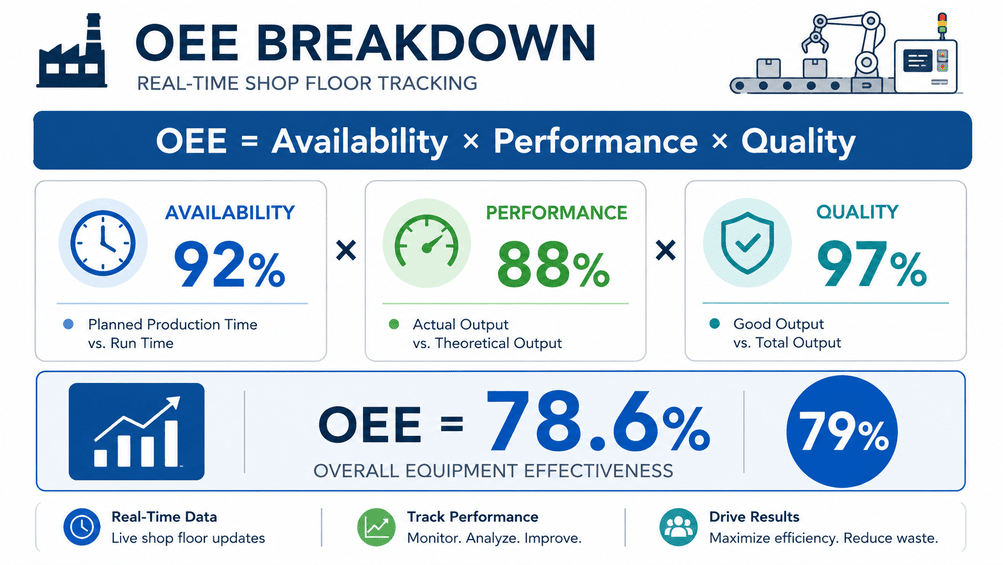
That is where manual capture breaks down. When operators round up downtime, miss the micro-stops, and estimate cycle times, both availability and performance are corrupted, and the OEE that reaches the morning meeting is one nobody fully trusts. Operations veterans who have watched a plant switch on automated capture for the first time describe a consistent surprise. The biggest losses are not the long breakdowns everyone talks about. They are the accumulation of micro-stops and changeover variability, the two-minute stalls and slow restarts that no one can log by hand while running a line.
The knock-on effect matters more than most leaders expect. Once those small losses become measurable, teams stop firefighting the dramatic events and start attacking the quiet, repeatable ones: the changeover that always overruns, the work center that always stalls after lunch. That is usually where the first real efficiency gains come from, and none of it is reachable while the data still lives on a clipboard.
What changes on the floor when the data is live
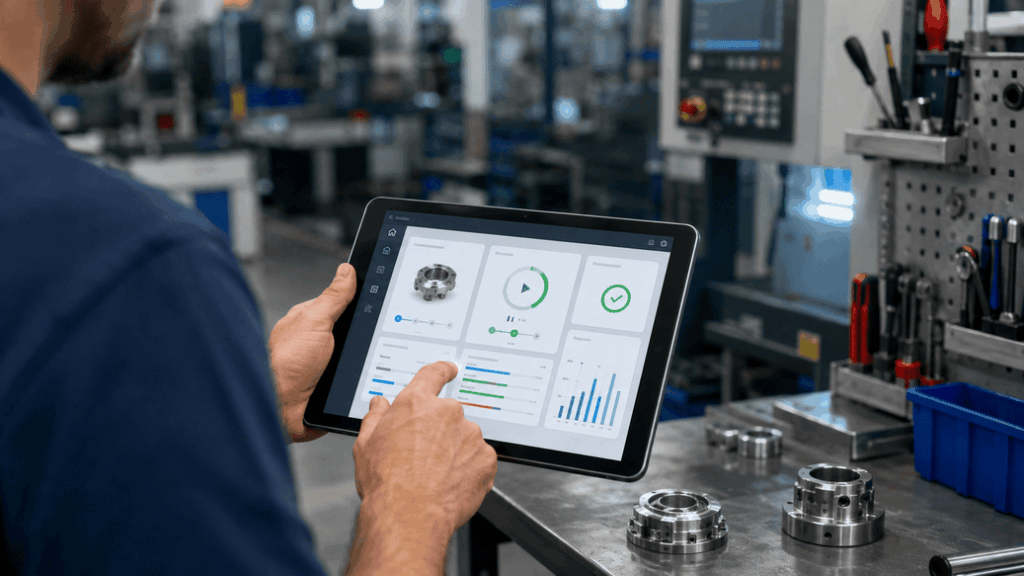
The shift is less about technology and more about tempo. When the floor writes back to the system in real time, the mechanics change at every level.
Operators stop doing paperwork and start doing their jobs. Instead of filling logs at shift-end, they clock time against each work order on the tablet, trigger a quality alert the moment a check fails, and block a work center when a machine goes down so no downstream order is released into a dead end. When the order closes, components backflush against the BOM, so inventory and work-in-progress valuation update without a separate transaction. Supervisors stop chasing verbal updates and instead watch live work-center load, the count of orders ready to start, and where the queue is backing up. When live availability changes, finite-capacity scheduling and the master production schedule can re-sequence against what is actually free, not against last night’s assumption.
The gains here are documented, not theoretical. In one documented 2026 case, a global consumer goods manufacturer lifted overall equipment effectiveness by 18% after automating shop-floor data collection on its production lines. That kind of jump rarely comes from buying new machines. It comes from finally seeing what the existing machines are doing. In another 2026 rollout, a manufacturer that moved sales, planning, stock, and accounting onto one connected system cut order-to-delivery time by 23% and operating costs by 15%. Real-time visibility also routinely surfaces 15 to 30% of hidden capacity, the output you have already paid for but cannot see. Reclaiming even part of the capacity you already own often means shipping more without adding a single shift, machine, or head.
Why bolt-on dashboards are not the answer
Here is where many plants take a wrong turn. They buy a monitoring tool, bolt it onto a few machines, and expect transformation. What they get is a sharper picture of the same disconnected reality.
Monitoring reports a single machine’s status: running, stopped, idle. It captures telemetry, but telemetry with no order context. It does not know which manufacturing order the machine is running, which customer that order is for, or what the consumed components cost. So it can show you a red light, but it cannot tell you which order is now at risk, re-sequence the schedule around it, or flow the variance into job cost. To do any of that, the execution data has to share a data model with planning, inventory, and costing.
This is the real reason bolt-ons stall. A stoppage on the floor should instantly ripple into the schedule, the stock position, and the cost of the job, and a standalone screen wired to a single PLC cannot reach into any of those. The connectivity layer still matters, capturing from modern controls over OPC UA and from legacy machines through gateways or the shop floor terminal, but capture is only half the job. The other half is that the captured event has to land in the same system that holds the BOM, the routing, and the ledger. That is the argument for treating your core system as an active control layer rather than a passive record. An ERP has to become an active control system, not a place where yesterday’s numbers go to rest. When the shop floor and the ERP are one system, as they are in a unified platform like Odoo, execution and planning finally speak the same language, and the plan stops being a suggestion the floor is free to ignore.
The gap is the real competitive line
The pressure is only building. Indian manufacturers are squeezed by rising input and energy costs on one side and stricter export and traceability demands on the other. Global buyers increasingly judge suppliers on digital capability, not just price and capacity, and traceability now often means unit-level lot and serial genealogy they can audit on demand. In that environment, the plants that win will not be the most automated. They will be the ones that closed the loop between the plan and the floor first.
Autonomy, the kind those flagship projects are chasing, is the far end of that road. You do not get there by skipping the operations layer beneath it. You get there by making the floor observable and the data trustworthy, one work center at a time, until the system reflects exactly what is happening the moment it happens. The factories that treat real-time execution as the foundation, not the finish line, are the ones that will still be standing when the buyers come asking what your plant can actually see.