
Every manufacturing head has lived this one. A line supervisor spots a fix that would shave twenty minutes off a changeover. The quality team finds a way to catch a defect two steps earlier, before it eats a whole batch. Everyone in the room agrees it is a good idea. A ticket gets raised. Then nothing. Six months later the improvement is still sitting in a queue behind forty other requests, and the supervisor has quietly stopped raising new ones. This is the process improvement bottleneck that almost no one names. It does not show up on a production dashboard. It is not a machine that broke or a supplier who missed a delivery. It is the slow distance between the moment someone on the floor sees a better way and the moment a system actually changes to allow it. In most growing manufacturers, that distance runs straight through one badly overloaded team: IT.
The short version of why this happens
Good process improvements stall in IT because almost every meaningful change to how work flows, a new approval step, a different inventory rule, a report that did not exist yesterday, requires someone to reconfigure or recode the systems that run the plant. Those systems are rigid, so each change becomes a development task. Development tasks join a backlog. And the backlog, in most mid-sized companies, is already months deep before your request even arrives. The fix is not hiring more developers to clear the queue faster. It is removing the need for most improvements to enter the queue at all.
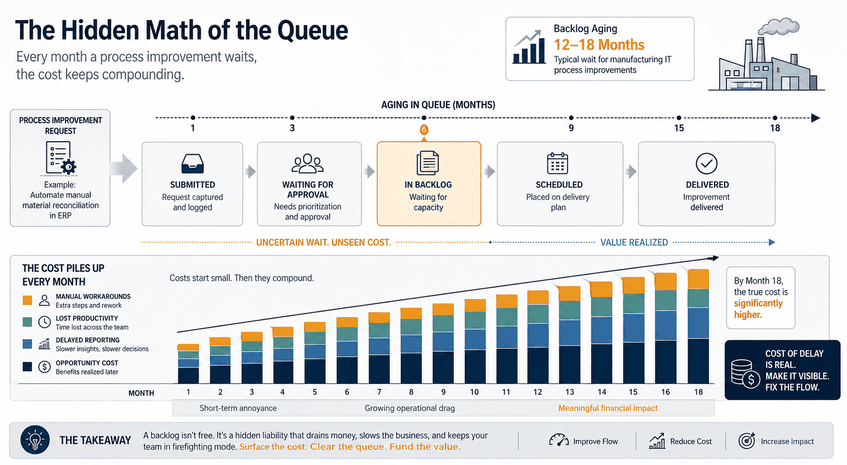
Most leaders measure the backlog by its length. The more useful number is its cost.
Start with how deep the queue actually runs. A 2026 analysis of mid-market technology operations found that internal development requests now wait, on average, twelve to eighteen months before they are built. That is not a worst-case figure, it is the norm. The same body of research shows that 72 percent of IT leaders say project backlogs are actively blocking them from strategic work, while demand for new internal tools is growing roughly five times faster than their teams can deliver. Your request is not being ignored. It is standing in a line that gets longer every week.
Now layer the manufacturing reality on top. The improvement ideas were never the scarce resource. U.S. manufacturers running structured process improvement programs reported 2.6 billion dollars in cost savings in a single recent fiscal year. The ideas exist. The savings are real and proven. What is missing is throughput on implementation.
Here is the part that appears in no ticketing system. Every month an agreed improvement sits in the queue is a month you keep paying the exact cost it was meant to remove. A twenty-minute changeover saving, delayed a year, is a full year of that waste still on your books. A defect check that would have caught scrap at station three, stuck in IT, is twelve months of scrap you chose to keep. Multiply that across the dozens of small fixes any active plant generates, and the queue stops looking like an IT inconvenience. It starts looking like the single largest source of unrealized savings in the building.
This is an architecture problem, not a capacity problem
When a queue is too long, the instinct is to add people to work it down. For this particular queue, that instinct quietly fails, and it is worth understanding why.
The backlog is not long because IT is lazy or simply understaffed. It is long because of how the work is shaped. In most manufacturers, the systems that run operations were configured once, often years ago, by a vendor or a long-departed consultant. Changing them means touching code or deep configuration that only a specialist can safely alter. So a floor-level improvement, something the supervisor could explain in two plain sentences, gets translated into a technical request, scoped, queued, and waited on.
That is an architecture problem wearing a staffing costume. The real bottleneck is not the number of developers. It is the fact that the people who understand the process best have no safe way to change the system themselves. Every improvement has to be handed across a gap, from the person who sees it to the person who can build it. That gap is where ideas go to wait, and often to die.
You can see the same pattern in the workarounds. When the official system cannot keep up, teams build their own. The spreadsheet empire quietly running your factory is what shadow process improvement actually looks like: dozens of unsanctioned spreadsheets and side tools that exist purely because the real systems could not be changed in time. They prove the appetite for improvement is alive and well. They also prove the official path is broken.
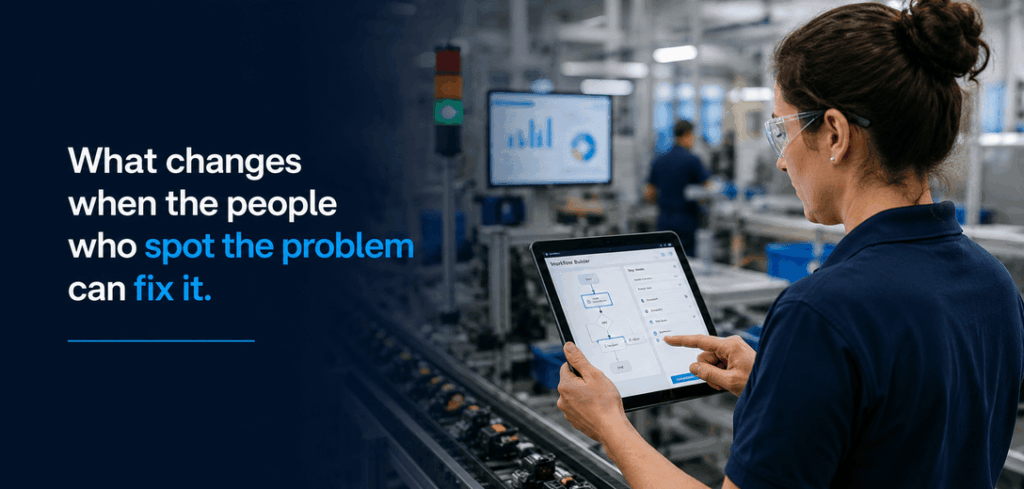
The manufacturers pulling ahead have changed the shape of the work, not the size of the team. They have moved to operational systems that the people running the process can adapt themselves, inside limits that IT sets but does not have to personally execute every single time.
This is the quiet shift from configuration to capability. Instead of every change being a code request, the common improvements, a new approval route, a modified inventory rule, a fresh report, become things an operations lead can set up directly. The deep, risky, architectural work still belongs to specialists, and it should. The everyday improvements no longer need to. This is the difference between an ERP that is configured once and one that becomes a living capability your teams keep reshaping as the floor changes.
The numbers behind this are not soft. A 2025 manufacturing automation report found that small and mid-size manufacturers who put cross-functional workflow automation in place recovered their full implementation cost within an average of seven weeks, mostly by eliminating the delay and error costs of manual, queue-bound processes. At the company level, the global manufacturer Ricoh documented a 253 percent return from adopting low-code tooling, with full payback in roughly seven months, by letting non-specialists build and adapt the tools they actually needed.
The pattern in both cases is identical. When the distance between spotting an improvement and implementing it collapses, the savings that were always theoretically available finally start landing on the books.
But doesn’t this just trade a queue for chaos?
There is a fair objection here, and any serious operations leader will raise it. If you let people outside IT change the systems, do you not just swap a slow queue for anarchy? Ungoverned tools, security holes, ten competing versions of the truth?
You would, if you did it carelessly. The answer is not a free-for-all. It is governed self-service. IT stops being the team that personally builds every change and becomes the team that sets the guardrails: which parts of the system operations can adjust, what data stays locked, what needs a review before it goes live. Inside those boundaries, the floor moves fast. Outside them, nothing moves without a specialist.
This is already the direction the industry is heading. Roughly 60 percent of custom business tools are now built outside formal IT departments, and about 30 percent of those by people with little or no coding background. Your shadow spreadsheets are proof that your teams will find a way regardless. The only real decision is whether that energy runs inside a framework you designed or outside one you are pretending does not exist. Governed self-service is how a growing manufacturer keeps the speed without losing control, even when growth starts to outpace the systems underneath it.
The real question
Here is the uncomfortable truth for any manufacturer that prides itself on continuous improvement. Your improvement culture is only ever as fast as the distance between insight and implementation. You can run every Kaizen event, train every supervisor to hunt waste, and reward every good idea, and still lose almost all of it to a queue that no one owns and no one measures.
The companies that win the next few years will not be the ones with the most improvement ideas. Every serious manufacturer already has more ideas than it can use. They will be the ones who shortened the path from idea to live change until it nearly disappeared. That is not really a software purchase. It is a decision about who is allowed to improve the business, and how quickly.
The improvements are already in your building. The only honest question left is how long you are willing to make them wait.