
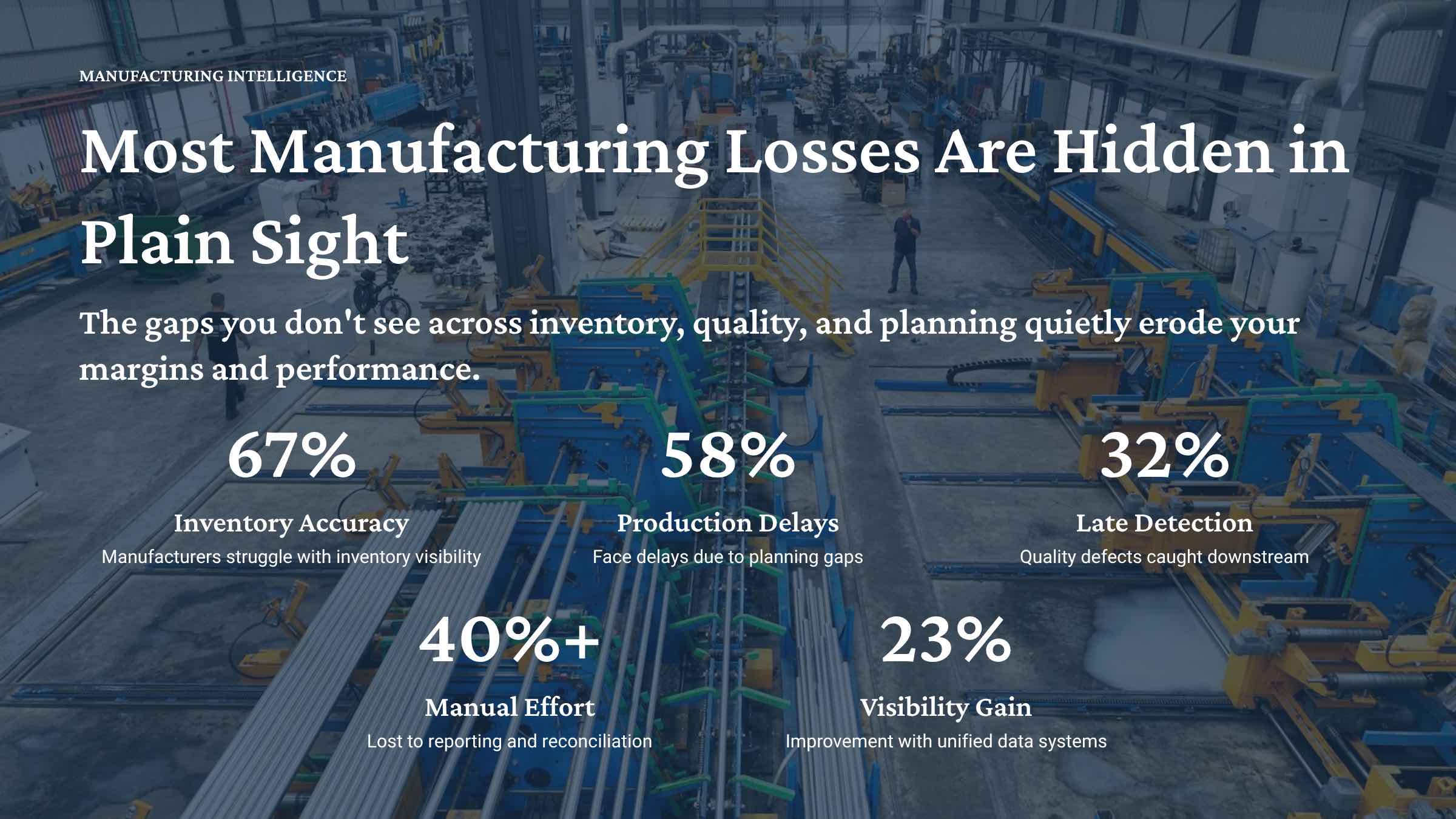
Most manufacturing losses don’t happen suddenly. They stay hidden until visibility improves.
Manufacturing Industry’s Reality
In most manufacturing businesses, losses don’t happen suddenly. They build quietly through inventory gaps, planning changes, and late quality issues. Most manufacturing teams don’t struggle because of a lack of effort. They struggle because information is fragmented.
- Manual reporting and reconciliation consume more than 40% of the effort.
- 58% of manufacturers face delays due to planning gaps.
- 67% struggle with inventory accuracy and availability.
- The process detects 32% of defects late.
- Decisions are made without real-time cost visibility.
These are not isolated problems. They are an everyday pattern across growing manufacturing operations.
What Does This Lead To?
When these gaps persist, the impact compounds quietly:
- Margins erode without a clear reason
- Teams spend more time explaining numbers than improving outcomes
- Firefighting becomes the norm instead of planned execution
- Decisions rely heavily on experience and intuition, not facts
- Leadership reviews focus on the past, not on preventing future issues
Over time, growth continues, but control reduces.
What Happens When Manufacturing Data Becomes Visible?
A clear view of manufacturing data leads to changes in behaviour.
- Plans reach the shop floor on time: Teams align faster and execute with fewer surprises, with production plans that consider material availability and capacity together
- Inventory is visible by location, status, and usability: fewer shortages, less excess, and better working capital control as the lot, serial, and expiry data remain linked end-to-end, and the material movement is recorded when it happens.
- Quality issues surface early: Quality checks are part of the process, not an afterthought.
- Costs are visible during decision-making: we manage variances proactively, rather than explaining them later, and our costs accurately reflect actual consumption, scrap, and effort.
- The leadership perceives a single version of reality: when work orders display the actual status, rather than assuming progress, the reviews take a forward-looking and reasonable approach.
The result is not more reports or dashboards. It’s calmer operations, better decisions, and predictable performance</strong >.
How to Choose the Right System?
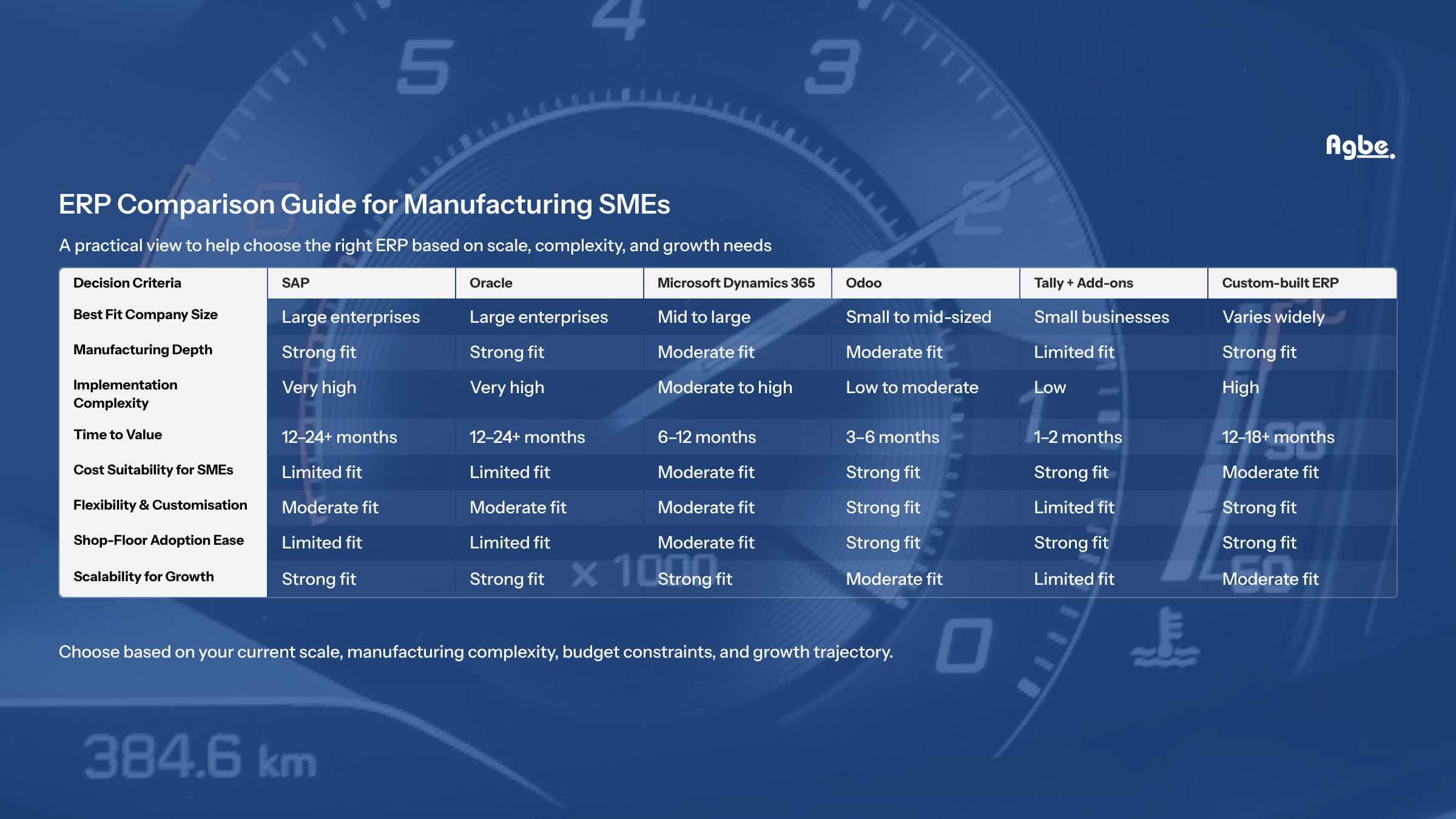
Today, manufacturers can choose from a wide range of enterprise resource planning (ERP) systems—from large enterprise platforms like SAP and Oracle to mid-market solutions like Microsoft Dynamics and flexible platforms like Odoo. Each comes with different strengths, costs, and levels of complexity. Some are designed for global enterprises with deep budgets and long implementation cycles, while others suit growing manufacturers who need faster results and easier adoption.
Choosing the right ERP is less about features and more about fitment. The right system should match your scale, industry, and pace of growth, support your manufacturing processes as they actually run, and be easy for teams on the shop floor to adopt. Equally important is the implementation approach – an ERP delivers value only when it improves visibility, discipline, and decision-making, not when it becomes another system to manage.
How Should You Think About ERP Choice?
Instead of asking, “Which ERP is best?”, you should ask:
- Does this ERP fit how our manufacturing actually runs today?
- Can our shop-floor teams use it without heavy dependency on IT?
- Will it grow with us without needing to be reimplemented for the next three to five years?
- Do we get real-time visibility, not just month-end reports?
- Is the implementation approach practical, not theoretical?
For most manufacturers, the ideal ERP strikes a balance between structure and flexibility, enhances discipline without slowing operations, and delivers value early, not years later.
Simple Rule of Thumb
- If you have a ₹50–300 Cr turnover, are multi-product and multi-process, and want faster ROI, then look at Odoo.
- If you are enterprise-scale with global compliance needs, then SAP or Oracle could be the right choice for you.
- Microsoft Dynamics is a good fit if manufacturing is light and finance is the main focus.