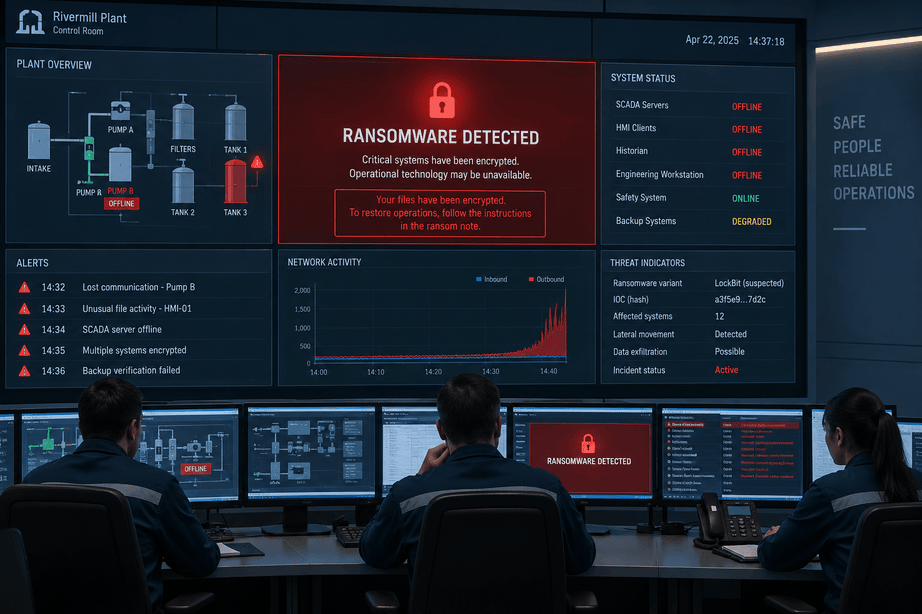
In the fourth quarter of 2025, a floor-care equipment maker with about $1.2 billion in annual sales, went live with a new ERP system in North America. The November cutover brought order management and fulfilment problems, scheduling issues and weaker inventory visibility. The disruption, a cost that belongs in any ERP total cost of ownership calculation, took about $22 million off adjusted EBITDA in that single quarter, by the company’s own estimate. Over the whole of 2025 the ERP programme itself cost $59.1 million, so one quarter of disruption equalled more than a third of a year of programme spend. No quote contained a line for it.
That gap is what ERP total cost of ownership is really about. If you are comparing quotes right now, the figure at the bottom of each page describes what the seller will invoice. Below is a way to rebuild each quote into a three-year picture that includes the lines nobody sent you.
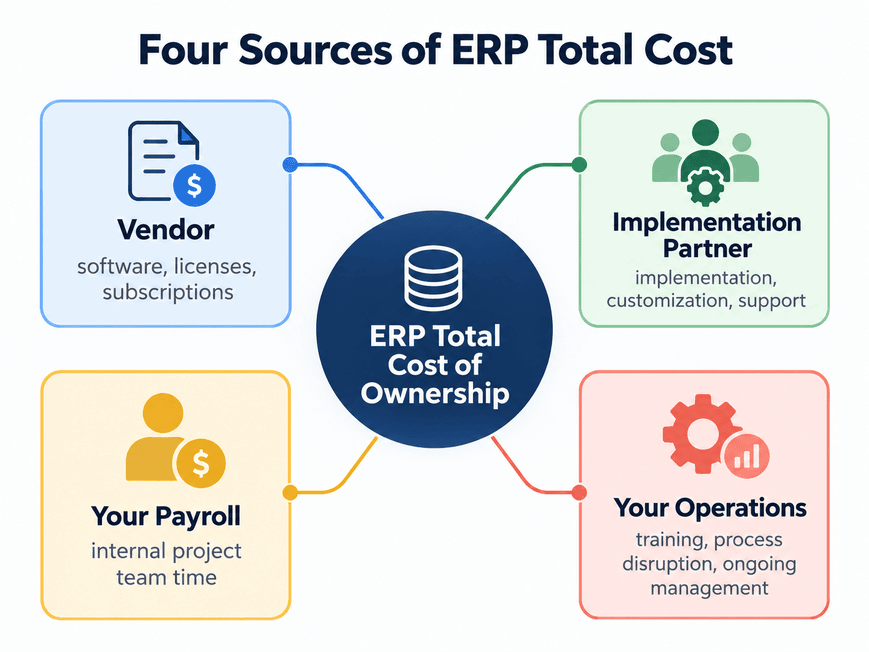
ERP total cost of ownership is everything the system costs you between signing and roughly year three, whether or not anyone invoices it. Four parties send that bill. The vendor charges for licences or subscriptions. The implementation partner charges for configuration, migration and integration. Your own payroll absorbs the hours your people spend on the project. Your operations absorb whatever the transition does to throughput. A quote covers the first and part of the second. A realistic ERP budget covers all four.
Read every quote by who sends the invoice
Two quotes for the same plant can differ by a factor of two, and both can be honest. The cheaper quote usually describes a smaller scope. Integration with your existing machine and accounting systems, data migration, additional modules and the first round of change requests are the lines that move to someone else’s invoice, or to a later phase described in a single sentence.
The pattern shows up in the data. In a 2026 independent survey of 170 organisations, about 30 percent of ERP projects finished over budget. Among those, 54.9 percent had to buy additional technology after the project began and 51 percent saw scope grow. Both are problems of fit, and fit is decided when you choose the system, long before anyone configures it. The invoice arrives during implementation, but the cause sits in selection.
You will also see average overruns of nearly 200 percent quoted online. They do not match this survey, where only 7.1 percent of projects went significantly over budget. The risk is real but concentrated in specific lines, which means you can check for it.
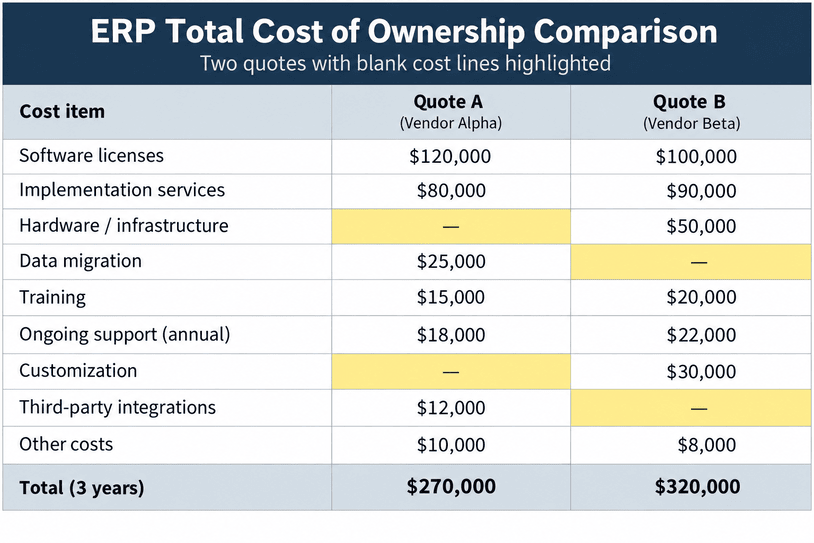
Put two quotes side by side with one row per cost: licences, configuration, integrations, migration, training, hosting, support, change requests, added modules. Wherever one quote has a number and the other a blank, you have found the real difference. Then ask each vendor to list every invoice you will receive over three years and who sends each one. How specifically and how quickly they answer tells you how often they have done this at your size.
Years two and three are where quotes go quiet
A quote ends at go-live. The costs do not. Once the system runs, people ask for the report it cannot yet produce and the extra module a department now wants. Each request is small. Together they become the largest recurring line in years two and three, and almost none of it was budgeted.
One 2026 implementation guide for mid-market manufacturers puts software at roughly 30 to 40 percent of first-year cost, with implementation, migration and integration running two to three times the licence. Treat that as a rough benchmark. The useful part is the direction: the visible line is the smaller one when you count ERP implementation cost honestly.
The sequence matters. Settle integrations and scope before you sign with the implementation partner. After signing, every addition is negotiated from a weaker position, with a team mid-project and a go-live date already announced. A proposal that describes a later phase in one sentence commits you to a future negotiation priced by someone else. Ask for a rate card for change requests and a written list of what counts as in scope for each phase. Then agree a year-two and year-three reserve with your finance team in advance, so the first change request does not become a budget argument.
Your own people are the biggest line nobody invoices
Nobody sends you a bill for your production planner’s time, which is why it is missing from most business cases and sits among the hidden costs of ERP implementation. In the same survey, underestimated staffing hours were cited by 35.3 percent of the over-budget projects, and the median project ran nine months.
Name the five people the project cannot succeed without. In most plants that means the stores lead, the production planner, the finance controller, a quality lead and someone from purchasing. Estimate each person’s weekly hours on testing, data checks and training colleagues, multiply by nine months, and cost the total at what it would take to backfill their day jobs. The figure is usually higher than anyone expects, because validation falls on exactly the people who know the plant best.
There is a tradeoff here. You can pay for backfill and keep the plant running normally, or let those people carry two jobs and accept a longer timeline and more errors. Neither option is free, and choosing deliberately beats discovering the choice in month five.
Watch for one early signal. If the warehouse team is still keeping its own spreadsheet a month after go-live, nobody rebuilt the one report they run their day on, and the system will soon hold two versions of stock. That pattern sits behind why user adoption is the number one reason ERP investments fail.
The most expensive week is go-live week
Return to floo care equipment company. After the November cutover it deployed recovery teams and interim workarounds, added on-site support, and in January shut its plants for two weeks to count inventory physically. It estimated about $30 million in lost sales for the quarter and about $22 million off adjusted EBITDA. Roughly 70 cents of every lost sales dollar reached earnings, because plant, payroll and overhead keep running while shipments stop.
The company is far larger than most plants reading this, and these are management estimates. The mechanism scales down. Take weekly shipments, multiply by the share of orders you could not ship, by the weeks of disruption and by your contribution margin, then add recovery labour. A plant shipping ₹10 crore a month that cannot ship 30 percent of orders for four weeks loses about ₹3 crore in shipments, roughly ₹1 crore of contribution at a 35 percent margin, before any recovery cost. That number belongs next to the licence fee.
You can reduce it, at a price. Phasing the rollout by plant or module caps the cutover loss but means running two systems in parallel for longer, with duplicate entry and reconciliation. A single go-live date finishes sooner and concentrates the risk. If you cannot afford a month of degraded shipping, phase it.
Test your data before you commit to a date. If stock on hand in the test system does not match a physical count of a sample of bins, you are not ready, and Tennant’s inventory shutdown shows what that costs after launch. The stakes are the reason ERP data hygiene is a board-level issue.
Customisation is a loan, not a purchase
Every piece of custom code works like a loan. The principal is the build cost, which appears in the quote. The interest is what you pay at every upgrade, when someone must retest the change and fix whatever it broke. That interest never appears in a quote, and it compounds with each addition.
The decision rule is to customise only where the process itself gives you an edge competitors cannot copy, such as a particular way of quoting, scheduling or costing jobs. Everywhere else, change the process to fit the system. A quick test: would a competitor’s plant run this step the same way? If so, the customisation buys you a recurring bill and nothing else.
Put one question to every partner before signing: when the next major version arrives, who retests our custom work, how long does it take, and who pays? The answer reveals more than the implementation estimate does.
This is also where the underlying architecture earns its place in the cost comparison. Systems designed to be configured through settings, modules and workflows leave less to code around, so less debt accumulates. Good workflow design up front is what keeps configuration from turning into customisation, and it is the subject of how ERP workflow design separates configuration from capability.
Before your next vendor meeting, take the quote you like best and rebuild it into the four-party view: what the vendor sends, what the partner sends, what your payroll absorbs, and what one bad cutover week would cost. Bring the blank cells with you. A vendor confident in their number will fill them in. One who cannot is showing you where the year-two surprises will come from. Whichever system you choose, you will be the one paying for the lines nobody quoted, and finding them now takes an afternoon with a spreadsheet and a few uncomfortable questions.