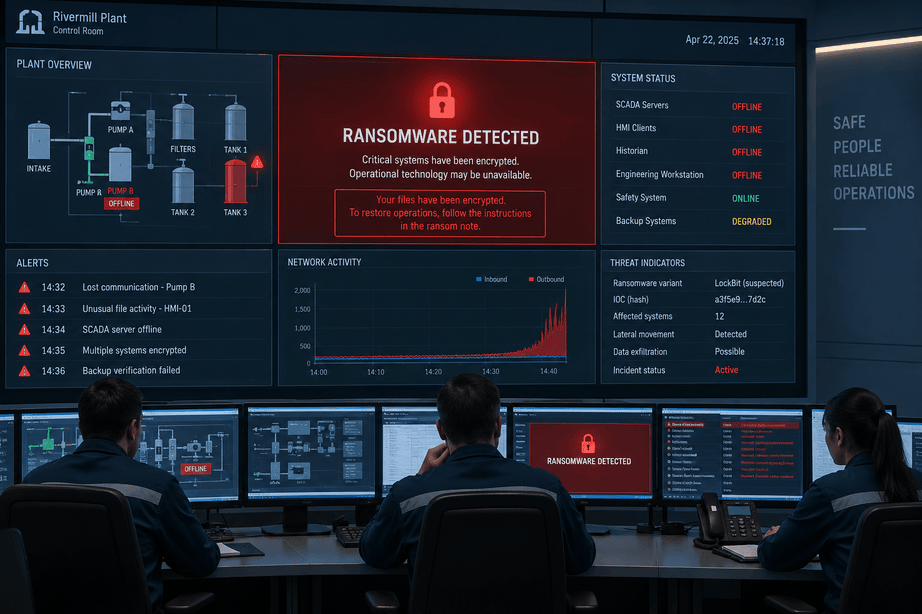

In late 2025, one of Britain’s largest carmakers stopped building cars. Not because of a strike or a parts shortage, but because attackers reached its systems and it had to shut down its own IT to contain them. Production at Jaguar Land Rover froze for roughly five weeks, around 5,000 supplier businesses felt the shock, and the modelled cost to the UK economy reached £1.9 billion, the most damaging cyber event in British history. Most of those suppliers were never breached themselves; they simply depended on a company that was. A cybersecurity gap assessment is supposed to surface exactly this kind of exposure. Most of them never look in the right place.
What a Gap Assessment Actually Is Now
A cybersecurity gap assessment is a structured review that compares where your security actually stands against where it needs to be, then ranks the shortfalls by business impact so leadership knows what to fix first. It is not a vulnerability scan, which hunts for known technical flaws in your own systems. A gap assessment examines people, processes, controls, and, increasingly, the trust you extend to outside parties. For a mid-sized company, the word gap has quietly changed meaning. It no longer describes only the holes inside your walls. It describes the space between your organization and everyone connected to it.
Why the Middle of the Market Is the Worst Place to Sit
Mid-sized companies occupy the least comfortable position in the entire market. You hold data worth stealing: payroll records, customer information, banking details, vendor portals, cloud admin access. You move real money. Yet you rarely carry the deep security bench a large enterprise takes for granted. That combination makes you attractive and thinly defended at the same time.
The danger is rarely a dramatic, movie-style hack. It is a normal gap nobody owned long enough to fix. Security in a growing company tends to accumulate as a pile of tools rather than a coordinated discipline, and the seams between those tools go unwatched. Someone assumes the alerts are being reviewed. Someone assumes the backups can be restored. Someone assumes a supplier’s access was switched off when the contract ended. In a lean organization, those assumptions rarely get tested until an incident tests them for you. A single overprivileged vendor login, left active six months after a project closed, is worth more to an attacker than any zero-day.
This is also why growth itself is a risk multiplier. Every new cloud app, remote worker, workload, and third-party connection adds another door to check, and the doors multiply faster than the people watching them. We’ve written before about how scaling introduces third-party and supply chain risk faster than most teams can absorb it, and the pattern holds across sectors. The controls that fit a 50-person company quietly stop fitting a 400-person one, and no single person notices the moment they broke.
The Gaps a Checklist Will Never Find
Here is where most gap assessments fail. They audit the inside of the building, declare it sound, and never notice that the front door has been handed to a dozen outside parties.
The numbers make the point sharply. A 2025 data breach investigations report found that third-party involvement in breaches doubled in a single year, from 15% to 30%, the largest jump the report has ever recorded. A separate 2025 cost-of-a-breach study put the average supply chain compromise at around $4.91 million and, more tellingly, 267 days to identify and contain, the longest lifecycle of any attack type it tracks. The reason is structural. When a trusted vendor’s credentials or software update carries the same authentication weight as your own, your alerts fire late, the scope is harder to map, and the cleanup drags for months.
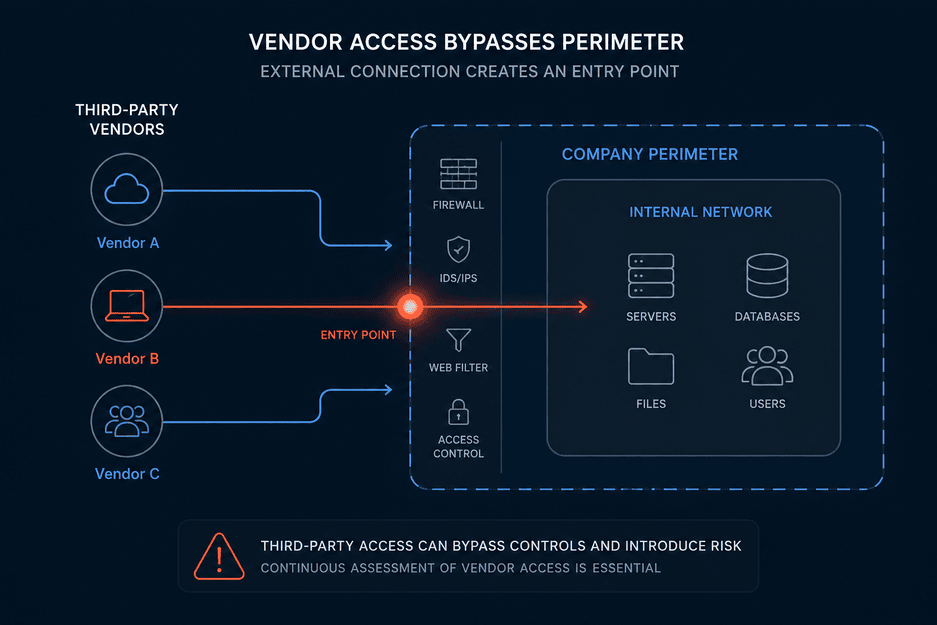
A checklist cannot see this, because a checklist asks whether you have controls, not whether the trust flowing through your business is governed. It is also why a passing audit offers such thin comfort. An organization can clear every box on a compliance questionnaire and remain wide open through a supplier account nobody reviews. That distance between a clean audit result and your actual exposure is one of the most common blind spots in mid-market security, and it is precisely the space a real gap assessment should probe. The right question is not whether you have multi-factor authentication switched on. It is which outside parties can reach your data, who approved that access, and when anyone last checked it still made sense.
Why This Belongs in the Boardroom, Not the Ticket Queue
For the C-suite, the meaningful shift is that supply chain security has become a commercial issue, not an IT one. As of 2025, roughly 60% of companies now weigh a potential partner’s cybersecurity when deciding who to do business with. Your security posture is now part of your sales proposition. Weak controls don’t just invite attackers; they lose contracts before a single line of code is touched.
The exposure runs the other way too. Cyber insurers increasingly demand proof of tested recovery and network segmentation before they will bind coverage, and large buyers are pushing security requirements down their supply chains as contract clauses. A gap that would once have been an internal embarrassment can now trigger a denied insurance claim or a lost renewal at the worst possible moment.
This is why a gap assessment belongs on the leadership agenda rather than the help desk queue. Its findings touch finance, legal, operations, and procurement, not just IT. When that automaker’s production stopped, the pain did not stay in the server room. It landed on cash flow, on suppliers’ payroll, on jobs, and ultimately on an emergency government loan guarantee to keep the supplier base alive. Treating cybersecurity as a narrow technical specialty, owned entirely by one under-resourced team, is exactly how those cross-functional consequences stay invisible until they arrive all at once. The mid-market companies weathering this best have started treating security as a shared responsibility across the executive table.
Turning a Report Into a Roadmap
A gap assessment is only as valuable as what happens after it. The failure mode is a thick document that gets saved, admired, and forgotten. The goal is the opposite: a short, ranked list of exposures tied to business impact, each with a named owner and a deadline.
That ranking matters because not every gap deserves equal urgency. An overprivileged vendor with standing access to financial systems is a different order of risk than an out-of-date policy document, and a good assessment refuses to present them as equals. It engages people from IT, compliance, and business leadership together, so risks are judged in context rather than as abstract technical scores. It separates the genuinely urgent from the merely untidy, and it hands leadership a roadmap it can follow and measure quarter over quarter, not a snapshot that expires the day it is printed.
Done well, the exercise changes the question a leadership team asks. Instead of asking whether the company is compliant, which invites a comfortable but false sense of safety, it asks where the business would break first and who owns fixing it. That is a far more honest place to begin, and a far more useful one.
The Question Worth Asking First
The lesson of the past year is not that mid-sized companies need more security products. It is that they need to see the parts of their business they have stopped looking at. The most expensive breach in British history reached thousands of companies that had done nothing wrong except depend on a partner whose defenses failed. None of them chose that risk deliberately. They simply never mapped it.
Every organization you connect to extends your attack surface, and every connection is a decision someone made, usually without asking what it would cost if it went wrong. A cybersecurity gap assessment, run with the supply chain in full view, is how a leadership team turns that invisible web of trust into something it can see, question, and govern. The companies that keep their footing through the next wave of supply chain attacks will be the ones asking that question now, on their own terms, before an attacker asks it for them.