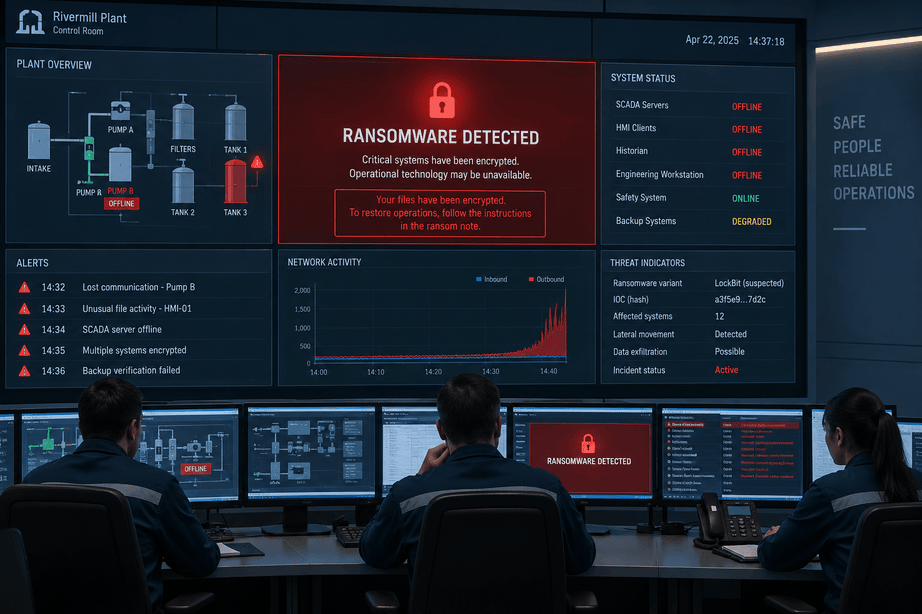
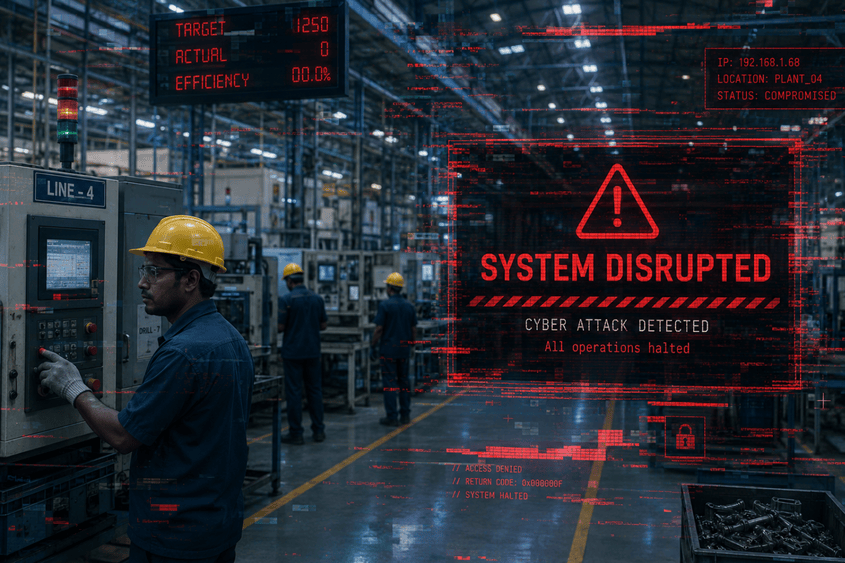
In 2025, one of India’s largest automobile manufacturers had to shut down an entire production plant after a cyberattack. Production stalled for over a week. An estimated 20,000 vehicles never rolled off the line. The perpetrators were never publicly identified. And this was a company with resources, with IT teams, with budgets most mid-sized businesses can only dream of.
Now consider the mid-sized auto parts supplier in Pune. The 200-bed hospital chain in Hyderabad. The packaging company in Ahmedabad running three shifts on a single ERP that hasn’t been updated in two years. If a company with global infrastructure can lose a week of production to a cyberattack, what happens when it hits a business with no dedicated security team at all?
The answer, for most mid-sized Indian companies, is simple: they don’t know. And that’s exactly where cybersecurity for small business in India stands today.
Indian mid-sized companies get breached through three specific doors: employee-targeted phishing attacks, unpatched or misconfigured systems left exposed to the internet, and compromised access through third-party vendors. These are not sophisticated, state-sponsored operations. They are routine, automated, and devastatingly effective against businesses that assume they are too small to be targeted. The good news is that closing all three doors costs a fraction of what a single breach does, often less than what most companies spend on office furniture in a year.
The Click That Opens the Front Door
The first and most common breach path into any Indian mid-sized company is the simplest one: an employee clicks something they shouldn’t.
Phishing and credential theft now drive roughly 73% of all confirmed breaches, according to the 2025 edition of a leading global data breach investigations report. That number has been climbing steadily, but what changed in 2025 and 2026 is the quality of the attacks. AI-generated phishing emails have seen a 4.5x increase in effectiveness. The grammar is flawless. The sender names are convincing. The urgency feels real. And the median time between a phishing email landing in an inbox and an employee clicking the link is under 60 seconds.
For Indian businesses, the exposure is compounded by how work actually happens on the ground. Critical business decisions move through WhatsApp. Credentials are shared across departments. The same password unlocks email, ERP access, and banking portals. A 2026 global cybersecurity study found that 49% of employees reuse the same credentials across multiple work applications, and 36% use identical credentials for personal and professional accounts. In a mid-sized Indian company where the finance manager, the plant supervisor, and the owner might all share a single login for the accounting system, one compromised password doesn’t just open a door. It opens the entire building.
What makes this worse is that 65% of small and mid-sized businesses globally still don’t use multi-factor authentication, despite the fact that MFA blocks 99.9% of automated credential attacks. That’s not a technology gap. It’s an awareness gap. The belief that cybersecurity is someone else’s problem persists even as the evidence piles up against it.
The System Nobody Remembered to Update
The second breach path is quieter, slower, and often invisible until it’s too late: systems that are misconfigured, unpatched, or simply left exposed to the open internet.
In early 2025, one of India’s largest stockbroking platforms disclosed a breach after dark-web monitoring flagged unauthorized access to its cloud-hosted resources. The investigation revealed that sensitive data for nearly 8 million users had been accessible through an unsecured cloud storage instance. The attackers didn’t need sophisticated tools. They used automated scanning to find publicly accessible resources and walked right in.
This pattern repeats across Indian businesses at every scale. A 2026 cybersecurity industry report noted that cloud misconfigurations, infostealer malware, and poorly secured APIs are now the primary drivers behind the surge in organizational cyber incidents in India. The country faces an average of 3,195 cyberattacks per week per organization, 62% higher than the global average. Many of those attacks are automated scans probing for exactly the kind of vulnerabilities that mid-sized companies tend to leave unaddressed: default passwords on admin panels, outdated server software, databases accessible without authentication.
The root cause is structural. A 2026 survey found that 84% of small and mid-sized business owners self-manage their cybersecurity. They don’t have a dedicated security person, let alone a team. The IT manager, if there is one, handles everything from printer issues to server maintenance. Security patches get deprioritized because the ERP upgrade took all month. The firewall rules haven’t been reviewed since installation. Nobody has run a vulnerability scan, ever. In fact, only 22% of small businesses perform regular vulnerability scanning, and just one in five conducts an annual penetration test.
The gap between how fast Indian companies are digitizing and how slowly they are securing what they’ve built is where attackers live. They don’t need to be clever. They just need to be patient.
The Vendor Who Brought the Attackers In
The third breach path is the one most mid-sized companies never think about: their vendors, service providers, and technology partners.
In January 2026, a ransomware group claimed an attack on an India-based IT services company, gaining access to virtual servers, customer backups, and over 150 GB of data including contracts and financial records. The group’s strategy is not unique, but it is brutally efficient: breach one managed service provider, and you gain access to hundreds of client environments simultaneously. By January 2026, the group had claimed approximately 50 victims using this supply chain multiplication approach.
This is not an edge case. A recent global breach analysis found that at least 29% of all confirmed data breaches now involve third-party attacks. For Indian MSMEs, the exposure is particularly acute because vendor security is almost never audited. The accounting software provider, the payroll platform, the IT support company that has remote access to your servers: each one is a potential entry point. And most mid-sized businesses have no visibility into whether their vendors meet even basic security standards.
The challenge is compounded by India’s interconnected business ecosystem. Manufacturing companies rely on dozens of subcontractors. Healthcare providers share patient data with diagnostic labs, insurance processors, and billing services. Each connection extends the attack surface beyond what the company itself can control. When one link in that chain breaks, the breach travels upstream.
Between 2024 and 2026, threat intelligence reports from Indian security operations centers identified third-party vendor access as one of three emerging risk categories, alongside AI-powered social engineering and attacks on operational technology networks. The trend is clear: attackers are no longer just targeting companies directly. They are targeting the ecosystem around them.
The Real Math Most Business Owners Haven’t Done
Here is where the conversation usually stalls. A mid-sized company owner hears about breaches, nods, and then asks: “But what will it cost to fix?” The assumption is that real cybersecurity requires a massive budget. It doesn’t.
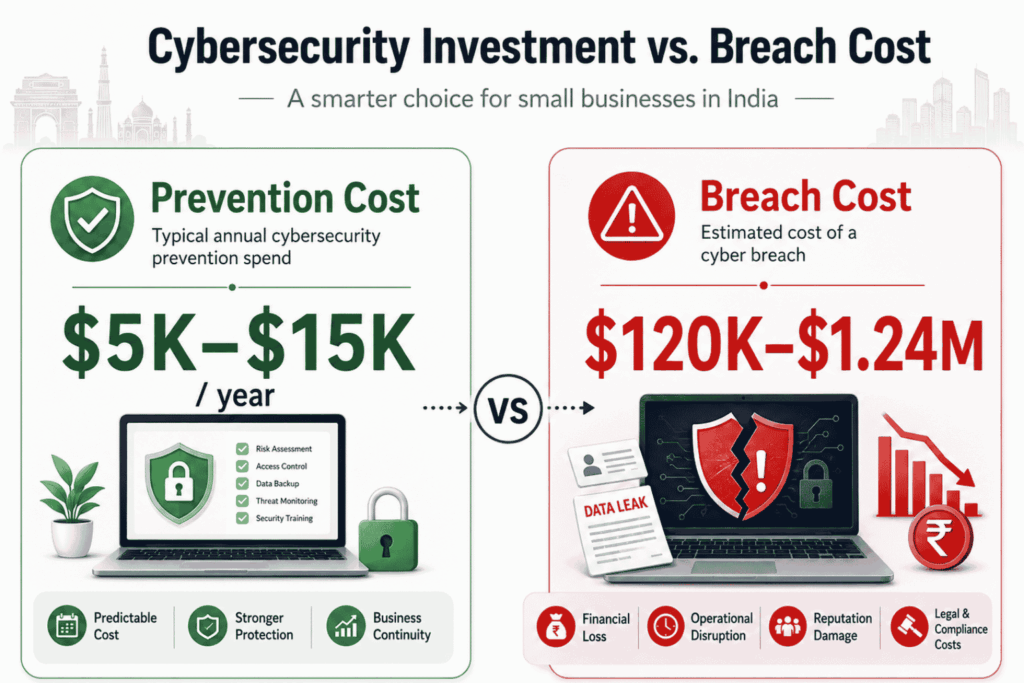
Basic cybersecurity prevention, including MFA deployment, employee security training, regular vulnerability scanning, patch management, and a tested incident response plan, costs between $5,000 and $15,000 per year for a small or mid-sized business. That’s less than most companies spend on annual maintenance contracts for their air conditioning.
Now compare that to the cost of getting breached. For companies with fewer than 500 employees, the average breach cost is $3.31 million according to a 2025 global breach cost study. Even at the lower end, realistic incident costs range from $120,000 to $1.24 million. Downtime alone costs approximately $53,000 per hour. And 40% of small and mid-sized businesses say a cyberattack costing $100,000 or less would put them out of business entirely.
The math is not complicated. Prevention costs 50 to 60 times less than recovery. A tested incident response plan alone, something a small business can build in a single afternoon, reduces average breach costs by over $230,000. Employees who receive consistent simulation-based security training are seven times less likely to fall for phishing. MFA, which costs almost nothing to implement, blocks virtually all automated credential attacks.
The question was never “can we afford cybersecurity?” The question is whether you can afford to keep operating without it.
The Decision That Separates the Companies That Survive
India’s digital economy is expanding at a pace that shows no sign of slowing. Cloud adoption, integrated supply chains, real-time payments, AI-powered workflows: every one of these is a genuine competitive advantage. And every one of them is also an entry point for an attacker if left unsecured.
The three breach paths described here are not theoretical. They are the documented, repeating patterns through which Indian mid-sized companies are losing data, money, and in some cases, their ability to operate at all. Phishing exploits the people. Misconfigured systems exploit the infrastructure. Vendor compromise exploits the trust.
None of these require a six-figure security budget to address. What they require is a decision: that security is an operational function, not an afterthought. That it gets the same attention as quality control, compliance, or financial reporting. The companies that will still be standing five years from now in India’s fast-moving digital landscape will not necessarily be the ones with the biggest IT budgets. They will be the ones that decided, early enough, to close the three doors that were already open.